Showing posts with label violence. Show all posts

Saturday, 7 November 2020

CHILDREN by Bjørn Larssen @bjørnlarssen

4.5 out of 5 stars

On Amazon UK

On Amazon.com

On Goodreads and BookBub


How I discovered this book: I read the author's Storytellers and loved it, so looked forward to this.

In A Nutshell: A re-telling of Norse myths

I'm not the ideal reader for this book, as all I know about Norse mythology is (very) basic information about Odin, Thor, Freya and Loki, what Valhalla and Ragnarok are, and that's about it.  Also, I am not a fan of fantasy, on the whole; magic and hallucinatory goings on - nah, you can keep it.  However, I was hugely impressed by Storytellers and had read some excerpts of this before it was published, which I liked a lot, so wanted to take a look at this.

The main characters, their stories told alternately and in the first person, are Magni, son of Thor, and sorceress Maya, who has had a somewhat difficult upbringing, not least of all under the watchful eye of the goddess Freya, one heck of a piece of work, to say the least.  I liked Maya; she was amusing and spunky.  I loved Magni; yes, even when he was taking part in raids on farms, and killing people.  

Children is atmospheric, clever, brutal, emotional, extremely well-written, intelligent, imaginative, and funny—and the dialogue is spectacularly good, some of the best I've read.  Now and again, the dialogue and Magni's inner thoughts made me laugh out loud, which rarely happens when I read.  The sexual activity in the book does not hold back, but get this: it didn't make me cringe.  And that comes from someone who almost always cringes at sex scenes.  Magni's feelings for Herjólf were so real, so well-portrayed; anyone who has ever been in love (or infatuated with) someone who remains elusive will feel Magni's pain throughout.

My favourite part was when Magni was first involved with the outlaws (I loved Ludo, too!), and I also liked Maya's encounter with Harbard, the idea of Idunn's fruit, Magni's conversations with his father, and the information about what each of the 'worlds' is all about, which interested me enough to look up more about Norse mythology.

Subject-wise, it wasn't absolutely my cup of tea, and I did get a bit confused with all the Norse names sometimes ('hang on, was that a person or a place?'), but it's definitely a novel of which Bjørn Larssen should be very proud indeed, and if the magical and mythological floats your boat, I would recommend that you buy it without delay.


Monday, 7 May 2018

SKINHEAD by Richard Allen

3 out of 5 stars

On Amazon UK
On Goodreads 


How I discovered this book:  This book first came out in 1970, the first and most well-known of a series of cult novels by Richard Allen.  I went to a fairly rough school from 1970-1972*, where the (scary) skinhead girls of the 3rd and 4th years would lend it to we 12-year-old babies.  It got passed round the whole class, and I remember it used to fall open at Chapter 8, the rude bit.  When I spotted the new digital version during an Amazon browse, I had to buy it to see how it had stood the test of time, and if it was as bad as people said it was, even then.

Genre: violence, crime, social comment.

Briefly:  The story tells of a couple of weeks in the life of Joe Hawkins, the 16-year-old leader of a skinhead gang from Plaistow, East London.

Violence - tick
Sexual content - tick
Nudity - tick
Bad language - tick
Racism - tick
Sexual violence - tick

It's hard to give this a star rating as there are so many elements to take into consideration.  As a piece of pop culture history, it's a gem.  The characterisation is pretty good, and it certainly kept me turning the pages.   Now and again clever insights are succinctly delivered, and the atmosphere of the time - the post-1960s optimism, pre-decimalisation era, when the East End no longer ruled, is so well illustrated I almost felt nostalgic for a time and place about which I know little.  A soldier, Jack Piper, who falls foul of Hawkins' bovver boots, talks about the fate of his working class parents in the dreariest part of London in a way that is quite heartbreaking.  The attitudes of the older working classes, particularly the police, to the new liberalism of the 1970s is, I dare say, spot on.

...but then there's the exposition, the bad punctuation (the proofreader from the New English Library, its first publisher, must have thought that a semicolon is a random alternative for a comma, whenever you feel like it), the exclamation marks, the lazy grammar... and, in places, lack of research/realism.  'Richard Allen' (pen name) was nearly 50 when this was written, and it's clear he doesn't know what the effects of 'pot' are, or even that it wasn't called that by anyone other than newspaper reporters.  He appears to think that all hippies, or 'hairies' (haven't heard that word since 1972!) are unemployed and indulge in regular orgies.  Joe Hawkins and his band of thugs never use the 'f' word, and call people things like 'stupid idiots', though the 'c' word does appear once or twice.  


It's really quite a horrible book, depressing and nasty, from Joe himself (who, Allen makes clear, is not the victim of social deprivation or an abusive childhood, but was born a psychopath), to the way women are portrayed (old bags or total slags), to the way in which the older people worry about the lack of control over the new breed of thugs.  Yet I kept turning the pages.  Go figure, as they say.

Oh, and by the way, the Chapter 8 'rude bit' is no stronger than anything you might read in one of today's mainstream 'steamy' romances.  In an age when you see more explicit stuff in network TV dramas than would have been included in under-the-counter soft porn films in Joe Hawkins' day, it is quite tame.  And actually not badly written.


*I was 'lucky' enough to experience the first year of easing into the new comprehensive school system, which meant not being able to go to the Grammar School until I was 13.  I think this had an adverse effect on my whole attitude to education, and possibly my whole life, because I had to learn to be rebellious in order not to get picked on by the rougher girls.  On the other hand, it probably taught me an interesting snippet or two that came in handy later in life, when I started writing. 

Sunday, 7 May 2017

WALLS OF SILENCE by Helen Pryke

3.5 out of 5 stars

On Amazon UK
On Amazon.com
On Goodreads


How I discovered this book: It was a submission to Rosie Amber's Book Review Team, of which I am a member.

I was not sure how to review this book at first, because it's a strange one; my opinion of it varied so much, all the way through.  It's a long novella (or a very short novel - I am sure it is no longer than 50K words, maximum). 

Warning: this review includes plot spoilers.  

Set in northern Italy, the story opens with Pietro, heartbroken over the loss of his wife, Maria, who has just died from cancer.  It then goes back to Maria's childhood in Sicily, in the late 1950s and early 1960s.  Maria lived in a small village, where life rolled by at the slow pace of fifty years before, and the Roman Catholic church and the family were the main focus.  I adored every word of this part; it's beautifully written, and I felt so sad when Maria's mother died, even though I'd met her only briefly.  Yes, the characterisation is that good.  The atmosphere of the time is simply yet vividly portrayed, and I was completely engrossed in the story. 

Maria's childhood takes a darker turn when her father remarries, and her 'uncle' Salvo comes to live with them.  Her account of the abuse she suffered is raw, poignant and utterly believable, and I loved that this part of the book showed not only the reasons for her silence, but also the way in which the simple, ill-educated population were manipulated by the rigours of formal Catholicism.  Stunningly good.  At this point I was going to give the book 5*, which is not a rating I give often. 

Skipping forward, a marriage is arranged between Maria and Vincenzo, when she is sixteen and he is in his late twenties.  They go to live in Milan, and the marriage is difficult, interspersed with brief moments of happiness.  They live in a squalid apartment, Vinny struggles with the prejudices of the northern Italians, he gambles, drinks, and eventually abuses her physically.  I felt this part was a little rushed, and I was sometimes a bit 'hmm' about Maria's reactions, but I was still enjoying it.  Eventually, Vinny's gambling spirals out of control, and he offers Maria up as a final wager in desperation to recoup his losses.  He loses, and Maria has to leave the house with her new protector, Matteo. 

It's now that the book trails off.  Maria is forced into prositution.  At one point, her flat mate, Lisa, gives her a tablet 'to take the edge off', which turns out to be LSD.  Girls in that situation are usually given (or choose to take) heroin or cocaine (or possibly dexedrine, in the 1960s), which give the illusion of wellbeing, not LSD, which is a powerful hallucinogenic and produces a 'trip', not the sort of drug that would be offered to 'take the edge' off anything; I suspected Ms Pryke had not done her research.  After a terrible few months, Maria meets Pietro, a young, professional man who falls instantly in love with her during their brief afternoon/early evening meetings.  Despite the danger involved with going up against Italian gangsters and the fact that he hardly knows her, Pietro hatches a plan to aid her escape, which involves them faking their own deaths and changing their identities.  For some reason I couldn't fathom, his parents (who, in the staid Italian 1960s, are perfectly okay about him potentially ruining his life for the sake of a prostitute he hardly knows) agree to orchestrate this preposterous plan.  I am afraid I could no longer suspend my disbelief at this point; I thought of at least three more convincing ways to end the Matteo section even as I was reading it. 

The book is wrapped up quickly, with details about Pietro and Maria's happy new life, her return to Sicily and reunion with her family.  Again, it was over too soon.  The reunion with Guisy should have been hugely emotional, but it felt raced through, with all information given about the people of Maria's childhood like a quick report. 

I am giving this book 3.5* but rounding it up to 4* on Amazon because the beginning was so very, very good, and because Ms Pryke can certainly write; I read it in one day and looked forward to getting back to it each time.  The main problem is that for the depth of plot it needs to be a novel the reader can become immersed in emotionally, not a short catalogue of disastrous events.  Had the second part, with Vinny, been extended, and the prostitution plot been less outlandish, it could have been a terrific book.  Sometimes, less is more; this author is talented enough not to need car chases and faked deaths.  The atmosphere of Sicily, the stark contrast between the 1960s and the 21st century, the characterisation and her simple knack of writing good sentences that keep the reader wanting to turn the pages, are enough.  And I'd definitely read something else by her.


Thursday, 10 September 2015

ANY MAN JOE by Robert Leigh

5 GOLD stars

Vigilante/crime drama/thriller

Currently unpublished


Reviewed by me as part of Rosie Amber's Review Team


Excellent, excellent - I thoroughly enjoyed this!

Joe is a quiet living young man who lives on a rough council estate in London, just minding his own business - until he becomes unwillingly mixed up in the world of the estate's drug dealers.  Pretty soon, he finds himself in handcuffs... that's all I will say about the plot, or I'll spoil it.

Robert Leigh has done it again, the same as he did in Kill Line - he's made me like and root for a mass murderer.  No, I'm not weird - read it, and you'll understand!  I still feel sad thinking about him.

Parts of this book reminded me of that televisual piece of excellence, The Wire - if you liked that, you'll love this.  Of course, this is South London, not Baltimore, but I imagine the drug dealing hierarchy runs much the same.  The story is told in alternating points of view, between Joe and DI Edwards, the officer originally in charge of the case.  It highlights police corruption and social problems, too - all very real.


The book is SO well structured, which is one of the elements that makes it work so well, with the story unravelling gradually, as we move from hospital to police custody to flashbacks back on the estate.  The dialogue and the characterisations of the dealers, the junkie who befriends Joe, the blinkered cops, are spot on.  The action is cleverly executed, too, making me able to visualise clearly what was happening - this is a hard thing to do, I've read so many that don't work.  The suspense is superbly suspenseful (!), as is the build up of Joe's frustrated outbursts.  A classy writer, this!

This is the second novel in Leigh's Retribution Trilogy - I can't wait to read the third.   It's a complete stand alone, the stories are not connected in any way, so you don't have to read Kill Line first (though it's so good, I would if I were you!!!).

KILL LINE by Robert Leigh reviewed HERE


FROM LIME STREET TO YIRGACHEFFE by Robert Leigh reviewed HERE


Monday, 10 August 2015

KILL LINE by Robert Leigh

5 out of 5 stars

Murder thriller

On Amazon UK HERE
On Amazon.com HERE

Reviewed by me as part of Rosie Amber's Review Team


I liked this book a lot, so much that I've already downloaded Robert Leigh's latest one, Any Man Joe.

Shaun Dolan works in a call centre, and murders customers who are unnecessarily rude to him.  Yet I still kind of liked the guy.  I didn't want him to get caught.  That's a real art - making the reader root for a brutal psychopath.  Oh dear, I hope it's not just me...


The strength of this book is the sharp observation by which the characters have been created, from Shaun's boozy mates, to the chav ex-girlfriend, to the begging victims Barry Johnson and the revoltingly pompous Derek Page-Dove (great name!), and, best of all, the ghastly, dreadful supervisors and management at Skymiles and Calltex call centre.  Well done, Robert Leigh - the section in the middle about the changeover from Skymiles to Elevation, with all its corporate BS, is a masterpiece - it's obvious the author has worked in one of those places, and the production of this novel must have made every soul destroying moment worth it.  The dialogue is spot on, with every awful buzzword and phrase these people use; yes, and don't they always refer to their staff, etc, as 'you guys'??!  Ugh!  


This is not a novel for the squeamish; the violence is graphic, and you'll want to weep for the victims.  But it's kind of funny.  If you can believe that.  Not laugh out loud funny, but witty and clever.  


I wavered between 4 and 5 stars all the way through it, eventually deciding on 5.  I think it needs some tidying up, I thought the Harry Collins part was too much, and I was a tiny bit disappointed by the ending, but these are very minor complaints (in fact, not even complaints), are only my opinion, and the good bits are so very good that I couldn't have given it less.


Highly recommended!

From Lime Street to Yirgacheffe by Robert Leigh reviewed HERE


Any Man Joe by Robert Leigh Reviewed HERE


Wednesday, 8 April 2015

ULTRA VIOLENCE by Mark Barry

4.5 out of 5 stars

Violent drama, football hooliganism

On Amazon UK HERE 
On Amazon.com HERE


The blurb:
Forty. Receding pate. Dental problems. Failing marriage. Delinquent son. Psycho boss parachuted in to cut the big earners.
A few lost marbles.
It hadn't always been like this.
He used to be a Face. A Player. A Terrace Celebrity. Now he’s just another faceless nobody on the brink of despair in a world he no longer recognises.
Yet, one freezing winter’s day, a chance meeting with a face from the old days at Notts County changes everything.
Especially when there’s an intriguing proposition on the table. One he may find difficult to refuse. 


I know nothing about and have zero interest in football, and the culture of organised football hooliganism fascinates me only in a horrified sort of way, but having recently read Mark Barry's fabulous Once Upon A Time In The City of Criminals I wanted to know more, so I chose to read this, his most successful book to date.

Something I've noticed after reading a book I've loved is that I can't always remember if it was written in the first or third person.  This is, I think, because the characters have come alive to the extent that I've been able to see inside their heads, whether their tale has been told in their own words or not.  Ultra Violence, however, has set a new standard.  It's written in the SECOND person, yet I still felt I knew the unnamed main character as well as if he'd told the story himself, or if I'd had it narrated to me.  Yes, that's right, a whole novel written in the second person, and it works so well.  A curious and clever choice and yet another indication of the talent of Mr Barry, who is fast becoming my favourite 'indie' of all those I've read.


Ultra Violence is depressing, it's sad, it made me feel fed up about how different things were in my own youth, it tells of the unsavoury, the prejudiced, the lacking in culture, the unwashed underclass of society (the Bullys!) and those who've wrecked their own lives, but I couldn't put it down.  The story alternates between the past and the present all the way through, until they meet at the end, a structure I always find effective.  Fabulous ending, too.  I love a great ending. I gather in the new edition there are two alternatives, but, alas, I had the old one on my Kindle.

Oh, and I still think the main character is a closet homosexual, by the way.  So closet he couldn't admit it to himself, perhaps.  Don't know if anyone else agrees with me.  From about fifty per cent in I was waiting for the Big Reveal....


ONCE UPON A TIME IN THE CITY OF CRIMINALS by Mark Barry reviewed HERE 


CARLA by Mark Barry reviewed HERE


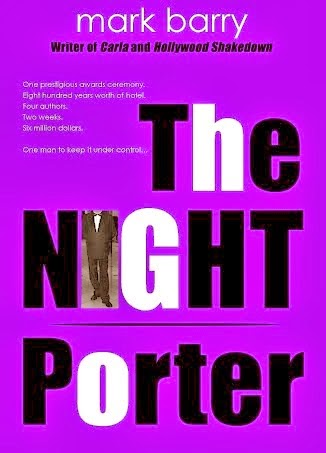
THE NIGHT PORTER by Mark Barry reviewed HERE 


Tuesday, 24 March 2015

ONCE UPON A TIME IN THE CITY OF CRIMINALS by Mark Barry

5 GOLD STARS

Violent drama

On Amazon UK HERE
On Amazon.com HERE


This book is of the type for which the 'indie' or self published world was made - fearless, quality writing that would probably never get taken on by a traditional publisher or larger independent press, because it fits into no established genre and would perhaps not appeal to the mass market, but for style and talent can rival the best and leave half of them standing.  This is the sort of novel that reaches cult status; maybe in five years' time people will be saying, "What, you haven't read City of Criminals?  Where have you been?"

I read it over a period of a couple of days and would have finished it sooner if I'd been able to.  It's terrific.

In brief:  Terry Valentine is an ex-con, a part-time crackhead, a ex-football hooligan, and a small-time crook with a chip on his shoulder about the middle classes and control of the populace by the rich.  Rapidly going to seed, he gets an emotional kick in the pants when he takes on the job of driver to young lesbian prostitute Chloe, and falls in love with her.  Once he gets into his head that she needs saving from her major client (who happens to be in love with her, too) and the gangsters who control her, all thoughts of a reconciliation with his one time love, sexy dope fiend Marge, go out of his head.

At first I worried that the free flowing writing style of narrative interspersed with Terry's inner dialogue, together with the lack of speech marks in conversation, might get on my nerves or even seem a little contrived, but it doesn't - it really works, more so as the book goes on, and is perfect for this story.  Mark Barry knows what he's doing.  The dark and dangerous underclass of brutal criminals, football hooligans, drug users and gamblers is obviously one he understands so well, too.  One thing I loved was the way in which the language of the world between the pages is not explained by some patronising glossary at the back of the book; if you're not sure exactly what is meant by a phrase or word on its first outing you soon pick it up, or if you don't it doesn't really matter. 

Barry has written before about a man with a serious dark side who falls hopelessly in love with and thinks he can save a woman half his age (in Carla), but this is an entirely different sort of novel, and by far his best of the ones I've read, I think.  What struck me most was that in the first half of the book Terry Valentine just seems like a bit of a sad case, but as the story moves on to violent confrontation you start to understand the mind of the type of man for whom only a fairly constant supply of class As (and large amounts of black market prescription medication) can replace the thrill of the brawl.  Although his feelings for Chloe are the basis for the whole story, it's about so much more. 

You'll like this book if you appreciate brilliant, sparky writing that doesn't nod to convention, if you have any interest at all in the football violence of the 1980s and gangsters in general, if the 'c' word and decidely unromantic sexual reference doesn't make you wince (actually, I found the sexual depiction in this book a lot less cringe-making than the would-be sexy bits added to many otherwise not otherwise erotically orientated novels these days.  It's real, it's not written to titillate; not an arched body or ecstatic moan to be seen). You'll like it if you're not put off by the mention of blood, and if you enjoy reading sharp, edgy, contemporary drama by a novelist who knows his stuff and isn't afraid to use it.

I couldn't put it down, abandoning my own work-in-progress in order to finish it.  It's fab, it really is.

CARLA by Mark Barry reviewed HERE


THE NIGHT PORTER by Mark Barry reviewed HERE


ULTRA VIOLENCE by Mark Barry reviewed HERE