Monday, 23 May 2022

WHAT WAS ONCE HOME by B K Bass @B_K_Bass #RBRT #TuesdayBookBlog

4.5 out of 5 stars


On Amazon (universal link)
On Goodreads

How I discovered this book: it was submitted to Rosie's Book Review Team, of which I am a member.

In a Nutshell:  Post-apocalyptic, alien invasion, set in southern USA.


Jace Cox is a young teenager when the 'twigs' invade - and after one August day in 2034 his life will never been the same.  Fast forward a few years and he's part of the militia fighting against them.  A few more years, and the town of Lewisburg has been reclaimed by its inhabitants, with Jace as its the sheriff - but the troubles are far from over.

Although I'm first in line when it comes to a post apocalyptic book, I wasn't sure I'd like one about an alien invasion, thinking it might be too comic book-like.  But this isn't.  B K Bass has made the subject totally convincing, and I really enjoyed it.  It's got a great structure that kept my attention throughout - although the main story is told from Jace's third person point of view in the early 2040s, there are occasional flashbacks to earlier, and also excerpts from the autobiography he wrote as an old man.  Aside from this, I loved the 'interludes' - sections told from other points of view in other areas, for a wider look at the situation.  These diversions from the main story were perfectly placed, and I could see how well thought-out the whole book is.

Bass has an easy writing style, creating good dramatic tension with a feeling of foreboding.  Every aspect of the book feels feasible, from the people who take charge in the new Lewisburg, those who want to be guided and given instructions, the fighting force, to the independent who want to do their own thing outside the walls - and, of course, the opportunity for the power-hungry to take over.

One small aspect I appreciated was how Jace, having been so young when the twigs arrived, knew little about life outside his immediate environment.  At one point an older person referred to a settlement as a 'hippie commune', and Jace didn't know what he meant.  I loved that!

This book gives food for thought about war versus murder, what is 'right' when it comes to defending your home and your people, what it takes to live in harmony alongside those who are different from you, and leaves a couple of unanswered questions, which made me think that another book, perhaps after Jace's time, would be most welcome.  I'd most certainly recommend What Was Once Home as a fine example of the post-apocalyptic genre.


Saturday, 7 May 2022

FORTUNATE SON by Thomas Tibor #RBRT #TuesdayBookBlog

4 out of 5 stars


On Amazon
On Goodreads


How I discovered this book: it was submitted to Rosie's Book Review Team, of which I am a member.

In a Nutshell: Coming of age story set in 1970, on a college campus in southern Florida.

Reed Lawson has a lot on his plate - he's juggling college and membership of the Reserve Officers Training Corps (ROTC), and his much revered father has been MIA in Vietnam for three years.  Then there are the droves of anti-war demonstrating hippies on campus, calling people like himself and his father 'warmongers'.

When circumstances lead him to volunteer at a community project giving help to people with drug and emotional problems, he falls for Jordan, a strident feminist and peacenik.  His life also becomes entangled with a younger girl with serious emotional and family problems.

I enjoyed reading this; the storytelling itself is fine, the characters are clear and three-dimensional, and the author certainly knows how to write convincing, appropriate dialogue, a talent I believe is innate - I didn't wince once, which says to me that the knack probably comes naturally to him.  Reed's conflicting emotions about his father, and his reaction to discoveries about his parents, were extremely well written.  Also, there were a few excellent passages about the time and feel of the era:

'The interstate had opened a few years ago.  Motels, fast food joints and gas stations mushroomed at each exit, sprouting garish oases in the rural countryside.  His mother hated the trend, predicting the country's regional charms would be bulldozed in a few decades to make way for chain stories and restaurants that peddled the same brand of blandness in every state.'

'He felt a kinship with all who'd travelled before him on thousands of miles of highway, which had replaced dirt roads, which covered trails hacked from raw wilderness.  Generations of restless Americans, forever on the move.  Pushing west, pushing south, yearning to go anywhere that promised to be better than where they came from.'

Although it's a good book and I liked it, I thought it could have been cut down by about ten per cent to make it tighter; it's quite long, and a fairly slow unfolding.  Also, the reminder of the era's culture was a little over the top - the frequent indication of what song was playing on the radio or floating out of a student's window, the way everyone's conversation revolved around drugs, Vietnam, feminism and their own existential crisis, constantly.  It became a little repetitive after a while.

Having said that, I would most definitely recommend it as a solid human interest novel and a good story, particularly if you remember or have an interest in the era.


Monday, 25 April 2022

UNDEAD by Mark Brendan #RBRT

3.5 out of 5 stars


On Amazon (universal link)

On Goodreads


How I discovered this book: it was submitted to Rosie's Book Review Team, of which I am a member.

In a Nutshell: Three macabre novellas of blood, terror and the living dead

In the first of these horror novellas, a man falls foul of the Spanish Inquisition and finds himself on a curious island where he comes under threat from unhuman terrors.  The second tale is about a necromancer in the eighteenth century, and the final one about some members of Napoleon's forces stationed in Northern Africa, who are looking for a way out of their situation.

All three stories are highly inventive, and I very much enjoyed some aspects of all of them.  My favourite was the last one, about the French deserters; this one really kept my attention and I was engrossed.  The atmosphere of the time was so well written, and I particularly liked the early scenes at the site of the battle.  I also liked the sections of the first one where the hero is a galley slave. The stories are fairly gory but not unnecessarily so; it worked.

I felt that the book, as a whole, could have done with a better copy editor/proofreader, as there were some wrongly used words and many punctuation errors, mostly missing vocative commas.  The content editing is fine; the stories flowed well and were told in a way that kept my attention. It was just the incorrect punctuation and other errors that should have been picked up, that distracted me.  Also, I felt that on several occasions the dialogue was too modern for the relevant periods in history.  Not horrendously so, but I think an experienced copy editor could polish them up to something first rate.


Friday, 15 April 2022

DARK HUNTER by F. J. Watson #RBRT #TuesdayBookBlog

 4 out of 5 stars


On Amazon (universal link)
On Goodreads


How I discovered this book: it was submitted to Rosie's Book Review Team, of which I am a member.

In a Nutshell: 14th Century murder mystery set in Berwick during the wars with Scotland.

This novel's background is factual; it centres around the early 14th Century territory wars between Scotland, led by Robert the Bruce, and England with its ineffectual King Edward II.  

Squire Benedict Russell has joined the English-held garrison of Berwick-on-Tweed, but soon finds that his attention is taken up by the murder of a young woman from a good family; he is given the task of finding her killer.

Rather than the murder mystery, it was the setting and the era that made me choose the book, as I love reading about both Plantagenet history and wars, and have been to Berwick several times.  I did guess the identity of the murderer early on, but this did not matter because, for me, Benedict's sleuthing activities came second to the book's greatest strength: the intricate detail about the people and how they lived, their customs, beliefs, every day life, all woven so seamlessly into the narrative, which flowed so well.  I've rarely read a piece of historical fiction that put me so much in the place and time.

There are a lot of characters, many with similar names so I admit to getting a tad confused at times.  I didn't know which were real and which were fictional; a short 'afterword' might have been useful, so that the reader could discover which fictional characters were based on actual historical figures, etc, and what happened afterwards (though I did hit the internet for more information after I'd finished the book!).

F J Watson must surely be something of an authority on the history of the town; I'd say this book is a must-read for anyone who lives in Berwick and is interested in its past.  Fascinating; one of those novels that makes you want to go back in time and see it all. 

Incidentally, I discovered on my first visit to Berwick that most consider themselves staunchly English, to the extent that some pubs and shops have the English flag in the window, though everyone I spoke to behind bars and shop counters had a Scottish accent :)


Sunday, 10 April 2022

WHY ODIN DRINKS by Bjørn Larssen #RBRT #TuesdayBookBlog

4 out of 5 stars


On Amazon (universal link)
On Goodreads


How I discovered this book: it was submitted to Rosie's Book Review Team, of which I am a member.

In a Nutshell: A Norse God with Imposter Syndrome...

I read the first episode of Bjørn Larssen's (very) alternative Norse mythology, Creation, which is now incorporated into this book - this is good, because I was able to re-read it before embarking on the confused All-Father's further adventures.

I think I would need to know a lot more about Norse mythology than I do in order to fully appreciate this, though I did look up bits and bobs here and there, which helped.  The idea of portraying Odin as rather hesitant and not quite sure of his role as ultimate creator, is inspired.  Problem is that he and all the other gods (and versions of Odin in the past, present and future) know about everything that will be (which seems logical, what with them being deities), but are not always sure whether items or concepts actually exist yet.  Like Odin's wife Frigg not being sure what a miniskirt is, but knowing she wants one. 

'What sort of tea will you have?'
'They haven't discovered it yet,' said Urðr.  'He looks like the lapsang souchong type to me, though.'

One of my favourite aspects was the occasional presence of 'literature'.  She is an entity that whispers to Odin's mind a piece of information pertaining to something that has just been said, such as 'Loki is foreshadowing', but Odin cannot see her; he just hears the sound of her sneakers as she sprints away.  I love that.

In parts 2-4 we meet many more gods - Loki, Freya and Freyr, and Frigg.  Freya, goddess of love, beauty, fertility, sex, war and gold (pretty much all the most important things to a Norseman, one imagines) is portrayed as a sort of Paris Hilton type, which I thought was genius.

'As he travelled, Odin thoroughly investigated people of all shapes and sizes, casually letting it slip that he was the All-Father'.

Some of the time the references went over my head because of my lack of knowledge of the subject, though other times I felt the prose needed a bit of tightening up; it seemed to career away with itself now and again.  However, the good is very very good, and I also liked the pertinent observations about life and death, time and war, woven amongst the ridiculousness.  And the ending.  Clever.

A light-hearted romp through Norse mythology, and a fitting development for Bjørn Larssen's comedic talent!


I laugh every time I look at this - the grinning Odin doing a thumbs up!


Monday, 4 April 2022

RIZZIO by Denise Mina #RBRT #TuesdayBookBlog

5 out of 5 stars


On Amazon (universal link)
On Goodreads


How I discovered this book: it was submitted to Rosie's Book Review Team, of which I am a member.

In a Nutshell: Novella about Mary, Queen of Scots

The first word that came to mind when I was thinking how to describe this book was 'enchanting', though the story itself is the very opposite.  The way in which it is written, however, is a delight indeed, even down to the off-the-wall chapter headings.  The shocking story of the murder of David Rizzio, servant, advisor and friend to Mary, Queen of Scots, bounces along in page-turning fashion, with a whisper of almost humorous cynicism as the author narrates the appalling events of the few days in question.

It is a chilling irony that the hornéd demons who stormed the Queen's apartments in Holyrood Palace claimed to be motivated partly by divisions in the Christian church - this grisly moment in history could have come straight from an anthology entitled 'The Devil and his Work'.  Also that the unborn child the demonic lords were so keen to write off actually became James VI of Scotland and James I of England - named by Elizabeth I as her successor.

Spoiled wastrel Lord Darnley - Mary's husband who threw his toys out of his pram when he didn't receive his 'Crown Matrimonial' (the sharing of the reign and the authority to rule in his own right if he outlived her) - was beautifully portrayed, while background information about the activities of his father and some of the other lords who took part in the brutality sent a chill up my spine that remains with me.  This novella brings home what a wild, dark and dangerous place 16th Century Scotland was - every scene is atmospherically perfect, and one is given the feeling that in aristocratic and 'noble' circles, one's life was hanging by a thread pretty much all the time.  

I loved what Denise Mina did with the insane Henry Yair, and the 'afterwards' section, when we read what happened to Mary in the years to follow and, most interesting of all, what happened to the Queen's apartments at Holyrood Palace.  Fascinating.  I have to look up more about this!

Excellent.  Loved it.

Monday, 28 March 2022

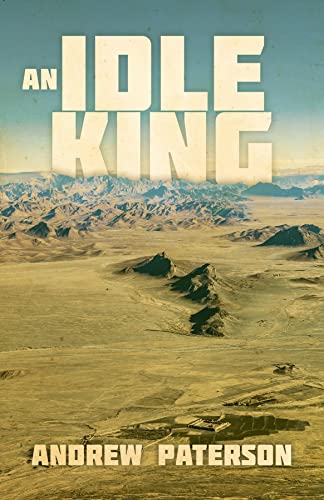
AN IDLE KING by Andrew Paterson #RBRT #TuesdayBookBlog

4.5 out of 5 stars


On Amazon (universal link)
On Goodreads


How I discovered this book: it was submitted to Rosie's Book Review Team, of which I am a member.

In a Nutshell: Military drama set mostly in Afghanistan

'An Idle King is a modern retelling of an ancient story about lost soldiers who can never go home.'

Callum King, a former army officer, is trying to come to terms with civilian life, including family difficulties and the depressing veterans' meetings.  Following news about one of his soldiers who was involved in the incident that led to Callum's discharge, he joins a team employed by a private security company, going back into Afghanistan for a chaotic, dangerous and mysterious mission.

That the author has a military background is clear from this book, not only in the practical detail but the way in which he describes the emotional state rigours of his characters.  The book is extremely well-written and certainly kept me turning the pages; Andrew Paterson has a good deal of understated talent.

The secondary characters are a fairly stereotypical bunch that one would expect in a story of this genre, whether in a book or a film - the naïve newbie, the brute, the big fatherly guy who doesn't talk much, the one female officer who becomes his right-hand-woman, the psychological wreck ... but because they're so well-drawn they didn't feel clichéd at all.  Callum himself is complex and confused; although the book is written in the third person, it still manages to show us inside his and others' heads rather than coming from a detached, omniscient narrator.

The revelation about the true nature of the mission comes as a shock to the reader as well as to Callum - it says a lot about this world, and none of it good.  There were so many quotes I loved, that spoke about the wider world as well as the country that Paterson clearly has great feeling for:

'Your people have been coming here for thousands of years trying to conquer our country.  You might as well throw sand against a mountain.'

'Habs spots a caravan of Kuchis trundling along the dried out riverbed ... mostly men in long wool coats, shepherding goats and sheep.  But some women, too, riding on the backs of camels or walking with small children in their arms ... together on some ancient migration, following routes seared deep into their forgotten histories.'

'Nation states are finished.  The future is the market state.  Instead of parliament and politicians, now the world's run by hedge fund managers and venture capitalists.'

'Callum knows all these men even though he hasn't met them before ... the scars on their faces, the missing limbs, the suffering in their eyes.  They're the children of war, soldiers in name only.  Boys who grew up without fathers.  Boys who were handed a rifle or the trigger to an improvised explosive device by old men who live far away ... and when the old men were finished with them, they were tossed aside like spent shell casings.'

'They're two old soldiers who went away to fight wars in far off places started by fat men for petty reasons.'

The ending is one of those that offers some resolution but not too much; it's sad and kind of mournful, but so right for the story.  It really is a very good book; I'd most definitely recommend.