Showing posts with label Tudors. Show all posts

Monday, 6 October 2025

A SONG OF SIXPENCE by Judith Arnopp @JudithArnopp

 5 out of 5 stars


On Amazon (universal link)
On Goodreads


How I discovered this book: from the back catalogue of one of my favourite authors.

In a Nutshell: the story of Elizabeth of York and Perkin Warbeck

Having recently read Judith Arnopp's latest book, about Margaret of Anjou (review HERE), I was still in Wars of the Roses headspace, and had to read more.  This starts a little while before Elizabeth of York (daughter of Edward IV and Elizabeth Woodville) marries Henry VII as a result of his victory in battle over Richard III.  Running alongside Elizabeth's trials, hopes, fears and joys as Henry's queen is the story of Perkin Warbeck, who claimed to be her brother Richard, one of the two princes in the tower whose fate remains a mystery to this day.

This book made me think of Phillippa Gregory's book The White Queen, in that Ms Arnopp has chosen the storyline that Perkin Warbeck actually was Richard; I liked this.  Her version is absolutely feasible, and ditto what happened to Prince Edward.  In fact, not just feasible but likely.

I liked Elizabeth, I wanted to like Henry, and was pleased when they found happiness.  Most interesting, also, was how Henry VIII the child was portrayed, and the differing personalities of his surviving sisters.  The Mary of this book absolutely would have run off and married Henry Cavill, no problem!

Loved it.  Every word.


Saturday, 5 July 2025

ALL THE KINGS BASTARDS by Gemma Lawrence @TudorTweep

 5 GOLD stars


On Amazon (universal link)
On Goodreads


How I discovered this book: A favourite author.

In a Nutshell: Alternative history: what if Henry VIII had died from his jousting accident in 1536?  Book #1 of a series.

I love 'what if' discussions and stories, and alternative history generally - I've read a few novels of the genre but this is easily the best.  Gemma Lawrence has excelled herself with this vision of how 16th Century life would have played out had Henry VIII died in the jousting accident that caused a gruesome injury to his leg; in the real world, this plagued him for the rest of his life.  Anne Boleyn was pregnant at the time and Henry had recently began his courtship of Jane Seymour.  Imagine: Anne did not miscarry her baby and he didn't live to marry Jane Seymour, so Edward VI never existed.  Catherines Howard and Parr had a lucky escape - and what of Anne of Cleves?  Most importantly, of course, Anne Boleyn, brother George and various others were not executed as a result of Cromwell's dastardly plot to remove them.

...and there is so much more.  The battle for succession: Elizabeth, Henry Fitzroy, Anne's unborn child, Mary Tudor.  By the end of this book Anne has not yet given birth but already the country is in uproar, with riots and violent divisions.

Ms Lawrence's historical novels are generally told from one first person point of view, but this is totally different, with each chapter focusing on one of a variety of players.  Anne, Mary, Jane Seymour, Spanish Ambassador Chapuys, Thomas Wyatt, Fitzroy and many others.  Insight into the world of the common man is provided through the eyes of Magpye Grey, the young daughter of an innkeeper, and also Thomas Blank, a Moor who once fought alongside Magpye's father; in her notes at the back of the book Ms Lawrence provides an eye-opening insight about the population of people of colour in England in the 16th century, little of which I knew about.  Throughout, there is much more detail about the day to day life of the time, which I loved finding out about (particularly the origin of the term 'straight-laced'!).

What I admired so much about this novel is that Ms Lawrence has considered every aspect of the court and beyond - altered fortunes for Robert Aske, Margaret Douglas, Margaret Plantagenet, Countess of Salisbury and the rest of the Pole family.  Will Fitzroy still die young, now he is in a different place?  The beginning of the book is fairly quiet, but the fall-out from Henry's death means that it soon gathers momentum, and it got better and better as it went on.  I think that the more you know about the history of this time, the more you will enjoy it; I kept thinking, 'oh, clever!'

Well done, Gemma Lawrence, you have mastered a new genre, and I cannot wait to read the next book!


Monday, 24 March 2025

UNDER THE EYES OF THE WORLD by G Lawrence @TudorTweep

4 out of 5 stars


On Amazon (universal link)
On Goodreads


How I discovered this book: last book in a series of which I had read all the others.

In a Nutshell: The last part of the life of Anne of Cleves.

This book picks up the story of the English court shortly after the death of Catherine Howard.  It follows the fortunes of Katherine Parr after she is chosen to become the last wife of Henry VIII, and the complicated web of manipulation, secrets and lies that follow his death, as the young Prince Edward takes the crown under the guidance of Edward Seymour and John Dudley, all from the point of view of Anne of Cleves.

In her role of first person narrator, Anne talks about the events taking place in her homeland, as well as international conflict and her thoughts on each player in the dramas taking place at home.  She has a deep friendship with Katherine Willoughby, Duchess of Suffolk and widow of Charles Brandon, who relates details of events to her; much of the book is dialogue-driven.

I liked the inclusion of fictional detail in this book, for instance the visit of Princess Elizabeth to Hever Castle; not a great deal is known about Anne of Cleves, so much of this book comes from the author's imagination and research into other areas.  Most interesting of all was the reign of Mary; I was thinking about her before I started reading this book, and it occurred to me that out of all Henry's offspring, Mary was possibly the one most like him, and that she took after him in personality more than she did Katherine of Aragon.  Elizabeth was so much her mother's daughter, but the older Mary was pure Henry, at his worst.  I very much liked the way Anne could see this happening, too; she had to deal with her own feelings about what her friend had become.

Compared with what happened not only to the other wives but to many women of nobility in those days, she was indeed fortunate.


Monday, 10 February 2025

THE SIX WIVES OF HENRY VIII by Alison Weir


4 o
ut of 5 stars


On Amazon (universal link)
On Goodreads


How I discovered this book: Twitter/X

In a Nutshell: Non-fiction account of the lives of the six queens

There is no doubt that this book is an exceptionally well-researched tome, with many quotes from those who were there at the time; this gives invaluable weight to those of us fascinated by these six women.

I did detect a certain bias; Weir has little good to say about Anne Boleyn, portraying her as a woman ruled by her ambition before anything else, though she mentioned the good works which Anne undertook without fanfare.  This, to me, made some of the other assumptions about her character seem less likely.  There is, of course, no doubt that Henry VIII was an overgrown child-monster who treated every one of them appallingly at some point during their time with him, but I've always believed (perhaps naïvely, I don't know) that Anne was as in love with Henry as he was with her.

I liked Weir's thoughts about Jane Seymour, that she was not just pushed forward by her family, but had calculated ambitions of her own.  I have long thought this, that she was not the retiring innocent flower of legend.  Catherine Howard I felt got a raw deal from this book, as it concentrated on her wanton ways rather than the fact that, as a child brought up without parents and siblings, she was preyed on by older men.  However, so much that we think or think we know about these famous ladies cannot be proven, so perhaps I read it with as much bias as that with which I considered it to be written - it's hard to assess!

I enjoyed reading this book, though I admit to skip reading some of what I considered to be rather laboured detail about the various political situations, though I can understand why it was included.

It's good, but I was a little disappointed in parts.

Monday, 13 January 2025

THE BOOK OF THORNHOLD by Judith Arnopp @JudithArnopp

GOLD stars


How I discovered this book: One of my favourite authors, saw this book from her back catalogue advertised on X.

In a Nutshell: A novel of long-short stories, about a family across the centuries

This is one of the best books I've read in ages.  The Book of the title was originally written by a priest in the 8th Century; it is passed down the centuries, with additions made by the generations who are fortunate to be its keeper in the place for which it is named.  Thornhold begins as a Saxon smallholding, and becomes a fine manor house.

It's a novel in the form of eight stories that are independent of each other but are held together by the same threads.  I loved them all, though I think my favourites were the chapter in the 14th Century, when the Thorn family weathered the Black Death, another about monks in a nearby abbey during the dissolution of the monasteries in the 16th Century, and a long one that centred around the Monmouth Rebellion of 1685 and its after-effects on the family.  I was actually reading that one in the early hours of this morning, and had to tear myself away from it!

The book reminded me of Norah Lofts' The House at Old Vine and A Wayside Tavern, and I was just as engrossed in Thornhold as I am when I read those novels.  I'm also quite relieved because I've been vaguely thinking of doing something similar for quite some time, but I know I could never write anything as good as this, so I can now shelve that project indefinitely!

In the introduction Ms Arnopp apologises for any flaws that have resulted from the re-hashing of this earlier work of hers, and I did notice the odd name with two different spellings and some erroneous punctuation; I mention this for two reasons.  Firstly, in case you're someone whose whole reading experience is spoiled by an ill-placed semicolon, and secondly (most importantly!) to illustrate how good this book is.  I am beyond picky about punctuation, but I loved this book so much that I didn't care if the character was called Dorcas or Dorcus or if an unnecessary comma popped up.

I am happy to say that if you love beautifully written and well-researched historical sagas, I guarantee you will enjoy this as much as I did.


Monday, 23 December 2024

A CLOAK OF FEATHERS by Gemma Lawrence @TudorTweep

 4 out of 5 stars


On Amazon (universal link)
On Goodreads


How I discovered this book: I'd already read the first two in the series

In a Nutshell: Book 3 of a series about Anne of Cleves

This third book in the Anne of Cleves series centres around events at Henry VIII's court, and Henry's marriage to Catherine Howard, told from Anne's point of view.  As the reader knows more about the situation than Anne did, it makes for interesting reading.  Her thoughts on the marriage and on her good fortune at escaping the dangerously volatile nature of her former husband make one feel most relieved on her behalf.

In this book, Anne talks a great deal about the lot of women in those times, and about male-female relationships in general; I liked the insight into the marriage of Charles and Katherine Brandon, too.  She also talks about Henry as a father, not just a husband, and his attitude towards the long-suffering Princess Mary.

I look forward to the next episode, to see what she makes of Katherine Parr, the activities of John Dudley and Edward Seymour, in their manipulation of Edward VI, and also the reign of Bloody Mary herself.  A quick look at Wikipedia told me that Anne died in the penultimate year of Mary's reign, so she never got to see what happened!  Mary fascinates me, so it will be good to read about her from Anne's point of view - and Anne's own story becomes more eventful during this later period, too.


Monday, 15 July 2024

THE SWAN MAIDEN by Gemma Lawrence @TudorTweep

 5 GOLD stars


On Amazon (universal link)
On Goodreads


How I discovered this book: a favourite author

In a Nutshell: Book 2 of The Surface and the Deep, the story of Anne of Cleves.

I thoroughly enjoyed this book, which starts with Anne's journey to England to meet Henry, and ends shortly after the annulment of the marriage.  The main body of it shows Gemma Lawrence at her best, when she writes solely about her character's own life and experiences, from inside her {the character's} head.  She has a truly exceptional talent for this, and I was completely engrossed, reading the book in the early hours when I needed to go to sleep!

Anne is portrayed exactly as I've always imagined her, as a dignified, kind and clever woman.  Her wise choice of accepting the annulment without complaint was aided, of course, by the fact that she was no more enamoured of Henry than he was of her, but there are some marvellous passages when she talks about her survival being far more important than any notions of foolish pride.

'...these things we create and take inside ourselves, these things we cling to and call pride and honour, they are meaningless... these things, they have meaning only if we think they do.  They are baubles, shining so bright we think they are the sun but the are shimmering surface reflecting only candlelight.  They are shadows.  Their light is a lie created by man, reflected back at us to dazzle our eyes and confuse our minds.'

Also, when she saw how the monasteries had been destroyed mainly to serve the greed of those already in possession of great riches, her take on another of the Seven Deadly Sins: avarice (or greed).

'...Yet these men did not know the truth, that this sickness for gold could never be cured by adding more gold to their purses or hands ... once within the veins of a man it did not feed him, it sucked the essence of his soul, the sickness of greed leeching all from that man until greed was all that possessed his mind.  It was a demon which crept into the skin of a person...'

I loved her impressions of the English culture and customs, as opposed to those of her own country, her observations about what was really behind the deterioration of the King's character, and his dislike of her.  I very much appreciated how Ms Lawrence has placed the spirit of Anne Boleyn in the shadows, too; a warning from history.

I expected the series to end with this book so was surprised when it didn't, but I researched a little and discovered that the story of Anne the Survivor has more strings to its bow than I realised, so I very much look forward to reading about her take on the marriage and reign of Mary, in particular.

High recommendation!


Monday, 17 June 2024

THE KISS OF THE CONCUBINE by Judith Arnopp @JudithArnopp

 4.5 out of 5 stars


On Amazon (universal link)
On Goodreads


How I discovered this book: One of my favourite authors, so more a matter of choosing which one I felt like reading!

In a Nutshell: The story of Anne Boleyn and Henry VIII

I was embarking on a long, lone train journey, so wanted a good, easy read book by an author I already knew and loved - this fitted the bill perfectly.  I know the story of Anne and Henry VIII like the back of my hand, so it was just a matter of settling in!

This view of Anne and Henry mirrors my own, and made me think, more than any other book I've read about Anne, that the periods of joy seemed so few and far between, even when Henry loved her - there was always doubt, insecurity, worry about what might lie ahead if she couldn't fulfil her promise to produce a male heir.  That her life was completely and utterly dependent on his whims.  Also, that out of the three siblings it was Mary, who had no aspirations or ambition other than to love and be loved, whose life ended the most happily.  


I liked very much how this is the story simply told; Ms Arnopp has resisted the need to weave in commentary about other aspects of the international or political situation, and, as in her marvellous trilogy about Henry, has written only from Anne's perspective.  It's so clever - for instance, I've always felt so sorry for Jane, George Boleyn's wife, who got such a raw deal out of life.  In this book we see her only from Anne's point of view, Anne who held a far more special place in George's heart than Jane did.  This is what I love about Judith Arnopp's writing - she never, ever falls into the trap of showing her own point of view, and is able to write solely from her character's head, even when she must surely know that the reader is screaming at the character that they've got it wrong.  To think again, to see a bigger picture, or the other person's point of view.

I especially loved the ending, which was beautifully executed, no pun intended.  From Anne's thoughts just before she died, to afterwards...

'I have seen you change from a prince into a monster.  I've witnessed every cruelty, every sin, seen each small betrayal, each moment of you, watched every discarded wife falter and fall.'


Monday, 13 May 2024

THIS WHITENESS OF SWANS by Gemma Lawrence @TudorTweep

 4 out of 5 stars


On Amazon (universal link)
On Goodreads


How I discovered this book: A favourite author; I read most of her books as they come out

In a Nutshell: Book 1 of The Surface and the Deep series, about Anne of Cleves

A most fascinating exploration of the wife of Henry VIII that we probably know the least about, showing that she was so much more than just a wife of Henry VIII.  She was, after all, the survivor, to a far greater extent than Katherine Parr, who lost and suffered a great deal more at the hands of the tyrant king.

Ms Lawrence has portrayed Anna of Cleves as I imagined her to be: more like the version brought to life by Joss Stone in the TV series The Tudors, than the 'Flanders Mare' of legend.  Educated, moral, reserved and dutiful, and quite realistic about her expectations of Henry, in this first book which covers the period from her childhood until her journey to England.

I very much liked reading the folk tales and the imagery of swans (I just love both the cover and the title of this book!) used in the narrative, particularly on, and also the part where her father dies; this was so poignant and real.  The whole story had a feel of three princesses in a fairy tale castle, somehow, though of course the real world kept invading.

I did feel that the book was a little research-heavy, particularly in the first half, in which much information about events elsewhere is given to the reader by way of dialogue; I felt this could have been trimmed down.  However, I enjoyed the final third of the book much more, and await the next episode with bated breath!


Saturday, 17 February 2024

A MATTER OF TIME by Judith Arnopp @JudithArnopp

5 GOLD stars


On Amazon (universal link)
On Goodreads


How I discovered this book: one I was waiting patiently for, after reading the first two in the series.

In a Nutshell: the life of Henry VIII in his own words, from the Anne of Cleves era until his death.

I loved this book!  Marvellous series, quite unlike any other historical fiction I have read.  Henry VIII in first person, present tense - a perfect choice, as the reader walks in his shoes with him, all the way.  Not for a moment does Judith Arnopp succumb to a possible temptation to broaden the point of view, in order to provide more factual detail.  It's totally Henry, all the way.  In the last book I noticed how events that might be given great significance in other works are hardly mentioned, because Ms Arnopp remains completely faithful to Henry's eyes alone.  

The question of Cromwell's lies about the infidelity of Anne Boleyn crops up a few times, as Henry is now able to step back and see the whole picture.  My impression has long been that his whole life was coloured by what he did to her, George, Norris and his other friends, as though he'd opened a door to a dark place that could never be closed.  One feels that Arnopp's Henry may not have actually believed Cromwell at the time, but convinced himself because he was so desperate for a son, exhausted by Anne and temporarily enamoured of Jane Seymour's timidity.

I found myself liking this older Henry, give or take the odd casually signed execution warrant or twenty.  I loved the section about Anne of Cleves (including how he began to see the merest hint of a spark of something between them...), and his delight in Katherine Howard was almost 'sweet'.  Karma or not, I felt so sorry for him when he was faced with the truth about her, the way in which his whole fantasy was torn away, revealing the relationship for what it was - and how it was the end of his fantasy about himself, too.  For one so obsessed with his own image, to see himself laid bare, as others saw him.  Saddest of all was his loneliness in his old age.  If only he could have used that time to get to know his children more.  And perhaps condemn fewer people to death...

Most ingenious of all, throughout the whole series, is that although ostensibly seen only through Henry's eyes, the thoughts of others and the truth about an event are often starkly apparent to the reader.  Now that's what I called skilled writing.  Bravo, Judith Arnopp!

Terrific series.  Can't recommend too highly.  I envy you if you have all three books yet to read!


Both painted during the 16th Century by unknown artists.


Sunday, 27 August 2023

THE MIND'S EVIL TOY (The Life and Death of Amy Dudley) by Gemma Lawrence @TudorTweep

out of 5 stars


On Amazon (universal link)
On Goodreads


How I discovered this book: A favourite author, was looking forward to it.

In a Nutshell: Historical fiction with a fantastical element.

Amy Dudley, neglected wife of Lord Robert Dudley, walks through the story of her life with him ... after she has departed this world.  She is led from place to place, from situation to situation, by her companion: Death.  The purpose of this journey is to uncover the truth, and thus allow her to rest in peace, behind not only her mysterious passing, but the crumbling of her once happy marriage, as the love between Dudley and Queen Elizabeth I deepens.

I'm not into the genre of fantasy at all, but this book worked for me so well.  I loved it.  It didn't feel like fantasy as such, I think because the events portrayed really did happen. 

Amy and Death discuss the machinations of her husband and his ill-fated relationship with the queen, shown to them via their invisible presence in scenes from the past.  I found this a perfect way to tell such a story; a straight fiction from the points of view of Elizabeth, Robert and Amy would not have been half so compelling.

The twist on the likely truth behind Amy's demise is clever and interesting, written in the mode of any good murder mystery, though the notes at the back of the book reveal the author's actual thoughts on the matter (I too am in agreement with the general opinion).  However, this is not all the book is about.  It's the story of a love that couldn't be, of ambition and deceit, of the Queen's triumph of sense over passion; it makes one ponder an abandoned woman's lot in such times, and also the value of life itself, with some wise observations from the not-at-all-demonic Death.

'The wisdom of others should never be ignored, but it should also never be followed with such slavish abandon that we forget to use the matter of our own minds'

'All things must end, that is the way of things. But other beings than me, grief, bitterness, resentment, these are the true enemies, for they steal life still there to live.  They make people think life, this precious and unlikely gift, is not worth living, and the worst of it is, it is a lie and people are tricked into believing it.  I am not the enemy, just the end.  Those who steal away life from those still living, they are the enemy'

It is observations such as these that reiterate to me why Gemma Lawrence is so successful at her chosen profession.  Well done.


Monday, 22 May 2023

SERVANT OF DEATH by Gemma Lawrence @TudorTweep

5 GOLD stars


On Amazon (universal link)
On Goodreads


How I discovered this book: Not so much discovered as awaited its release with great impatience!

In a Nutshell: The sixth and final installment of The Armillary Sphere series about Lady Jane Rochford, who served five of Henry VIII's queens and was married to George Boleyn, brother of Anne.

When I finished this book I felt a gap in my reading life; I kept subconsciously thinking I had it still to go back to then realising, with disappointment, that I hadn't.  LOVED it, probably the best of the series.  

Servant of Death takes us up to the downfall of poor sweet Catherine Howard and, of course, Jane.  If it wasn't for the fact that he was a murderous, self-absorbed tyrant who gave new meaning to the word 'narcissist', one could almost have felt sorry for Henry VIII, so cleverly has Ms Lawrence described how he adored Catherine and thought he'd finally found his perfect woman - though actually what he adored was his fantasy of her, as he neither knew her nor had any inkling that she lived in fear of him, not love.  His 'love' for her was but a reflection of the image of himself that her presence provided.  In this book we see so clearly the desperation that he thought was his own secret, not knowing how everyone else could see that Catherine was his last hurrah, as in vain he tried to stop the last grains of youth falling through the fat fingers that signed the death warrants for wives and friends alike.

This series has shown how, throughout her life, Jane was in the shadows of everyone else's dramas, with little opportunity to find happiness for herself, or even to work out what that happiness might have included, had she the freedom to find it.  As well as Catherine's times with Culpepper, I was glad for both her and Jane that they found comfort in their friendship; both their lives were robbed from them by the men in their world, from the very start.  In this finale, more than in the other books, the sense of women having no control over their own lives is starkly shown.  

The slow build-up to the point when Jane and Catherine were placed under house arrest (or apartment/chamber arrest, I suppose) was horribly sinister, especially as there was a whisper of what was happening on the wind.  I wondered how Ms Lawrence would depict Jane's alleged lapse into insanity at the end of her life, and the way in which she did so was most convincing; I felt almost as though Jane was freeing herself of society's behavioural requirements, and allowing her head to go in whichever direction it pleased.

I highly recommend this whole series, particularly the last three.  Highly, highly, highly - and two days on, that gap in my reading life remains.


Monday, 27 March 2023

A MATTER OF FAITH by Judith Arnopp @JudithArnopp #TuesdayBookBlog

 5 out of 5 stars


On Amazon (universal link)
On Goodreads


How I discovered this book: have been looking forward to it since reading the previous episode!

In a Nutshell: Henry VIII - the Anne Boleyn and Jane Seymour years

I zipped through this in two days.  Judith Arnopp's writing flows with such ease; when starting one of her books, I inevitably look up and wonder how come it's 2 in the morning and I'm already a third of the way through!

In this episode of Henry VIII's life, he has just married Anne Boleyn and is still, after 5 years, obsessively in love with her.  His version of love, at least; when she fails to produce a son and heir, and forgets to be her beautiful, charming best after giving birth/experiencing a devastating miscarriage, he begins to inch away.  Into the arms of Jane Seymour he falls - this time his 'love' only lasts a year or so, when he begins to see her as dull, frigid and uninteresting, rather than delightfully quiet and biddable.  Though she does produce the required prince, so after she dies (a fortnight after the birth), he fancies that he did love her, after all.


The way in which Ms Arnopp has written Henry in this phase of his life is so very clever.  The boy who lost his mother at such a young age, always aware that in his father's eyes he would always be the spare, rather than the heir.  As can so often happen, childhood insecurity becomes self-absorption in maturity; he searches constantly for confirmation of his popularity, his talents, his virility, his strength and, of course, his desirability.  Rarely if ever does he consider the feelings or needs of others; they are of no consequence.

The book is written in the first person, and Henry comes across as childlike at almost all times.  When his health and looks are ruined by his own self-indulgence, a ghastly leg injury and the ageing process, when his appeal to his subjects is greatly hampered by his brutal decisions, when those who loved him are no more (at least half of them by his own hand), he kicks out and hurts those around him.  The way in which he scarcely mentions some key events was, I thought, so artfully executed; if a circumstance does not affect him directly, so it remains on the shadowy periphery of his orbit.  Even the deaths of Robert Aske and his cohorts gain little mention; always Henry can justify his own actions.


This is not a long book and now and again I would have liked a little more detail like, for instance, how he was affected by the death of Thomas More, but, then again, one cannot fail to notice that the most devastating events (such as the murder of Anne and his men) are skimmed over the most quickly of all.  As though he cannot even bear to think about them, so pushes them out.  Now and again there is insight into his own pain - it was not just Katharine and Anne who lost all those children.  Each time, was he sent straight back to the pain of losing his little sister, Elizabeth, as well as his mother?  Were the murders of Anne, George, Norris, Brereton, Weston and Smeaton more than he could bear?  

This is not just another account of the Boleyn/Seymour years, but a rare insight into the mind of the man who made it all happen. A round of applause, and I can't wait to read the next instalment!


Monday, 30 January 2023

MY LADY SPY by Gemma Lawrence @TudorTweep #TuesdayBookBlog

5 GOLD stars


On Amazon (universal link)
On Goodreads


How I discovered this book: a favourite author, a great series, I was looking forward to it rather than discovering it!  Originally discovered Gemma Lawrence via Twitter; first read her work on Wattpad.

In a Nutshell: Book 5 of the Armillary Sphere series, about Lady Jane Rochford.

Easily my favourite book in this series so far, My Lady Spy is set during Lady Jane's time at court during the reign of three wives of Henry VIII: Jane Seymour, Anne of Cleves and Catherine Howard.  

Jane Seymour

The slight psychic abilities that Ms Lawrence has given Jane are beautifully written in this book; the one that sticks in my head, in particular, is her momentary vision of how Catherine's life might have been had the King died during their marriage.  In another writer's hand this somewhat supernatural element could have seemed out of place in a novel with such factual credibility, but Gemma Lawrence gets it just right.

Anne of Cleves

When Jane is coaching the ladies in her charge, as preparation for the arrival of Anne of Cleves, much is explained about the protocol of the court and the day to day life of those who lived there; I enjoyed reading this very much, and also the way in which life in London is portrayed.  I also loved the way in which Jane's own inner story develops in this book, as she deftly controls her obligations to Cromwell while dealing with her own loneliness and sadness, and her loyalty to her true masters: all three queens.  All hail Anne of Cleves, perhaps the most clever of all six, and certainly the most fortunate.

The story of Jane's close friendship with Catherine Howard is heartbreaking to read, knowing as we do how it must end.  I was glad it brought them both some happiness for a while, however short-lived.

Tamzin Merchant as Catherine Howard in The Tudors

This novel gives much grim detail about the ruthless, evil dissolution of the monasteries, and makes all too clear the daily tension of living in a world where one never knew what the tyrant King would do next; on several occasions I saw certain parallels with our world now.  History repeats itself in many ways!

'Common people, noble too, did not welcome all that had happened over the past three years.  Elements of life left unchanged, stable for generations, for all time as far as the collective memory of the people understood, had altered beyond recognition in a matter of months.  The world, once stable under our feet, was trembling, and the people did not like it.'

'If those in ultimate control of us are evil then there is no hope for us, so we blame others.  We make our masters, these tyrants, innocent so we remain safe in their power.  Fictions control more of the world than we realise.'

'When tragedy comes for one, it comes for all.  Evil does not affect but one of us, not just a few, but permitting evil, standing aside as it rides towards us, allows it into our world, and all our world it poisons, a little at a time.'

This episode ends as Catherine Howard marries the King, and as Cromwell gets his just deserts (head removed from body).  I loved everything about this novel, and only wish Book 6 was already available!

Jane


Monday, 17 October 2022

CAPTIVE OF THE KING by Gemma Lawrence @TudorTweep

 4.5 out of 5 stars


On Amazon (universal link)
On Goodreads


How I discovered this book: one of my favourite writers; I've been following this series.

In a Nutshell: Book 4 of a series about Lady Jane Rochford, set during the reign and downfall of Anne Boleyn.

The fall of the Boleyns is such a terrifying and sad story, and Gemma Lawrence has told it here in a most compelling fashion from the point of view of Lady Jane Rochford, George Boleyn's wife.  

Reading about the period after Anne, George and their friends had been executed, leaving Jane all alone and out of favour with just about everyone, I was struck by the way in which her whole life was lived in relation to other people.  In the notes at the back, Ms Lawrence described Jane as the watcher, just out of focus; isn't that perfect?  Jane felt that without her status as George's wife and one of Anne's senior ladies, she faded away.  The feeling I had about her was more than that, though; I noticed, throughout, that there was nothing in her life that was just for Jane.  Scarcely a book, a favoured food, a pastime, a preference.  As though it never occurred to her that what she wanted mattered.


Her childlessness must have had a huge impact on her feelings of worthlessness and invisibility; I am sure the way Ms Lawrence has portrayed her is close to the truth.  Although during the first third I felt a little frustrated by the book being more about Anne than Jane herself, told in reported and overheard conversation, I daresay that this is a good representation of Jane's life.  That only her involvement with others gave her existence any validity.  Her days were marked by events at court, even when she was not there, rather than anything that actually happened to her.
*

'There were no morals in the world anymore, just varying degrees of monster'.

...and the greatest monster of all was the King himself.  A small man who gorged himself and postured, to fill the emptiness inside.  Reading historical fiction about his reign (mostly by Ms Lawrence), I have long felt that he deeply regretted what he did to Anne and all those others who'd died on his watch, and his conscience could not deal with it.  Though he appeared to have little conscience during the dissolution of the monasteries, for his own vanity and to distribute largesse amongst those currently in favour.

I like how, in this series, Jane is given slight psychic abilities.  Nothing too outlandish, just enough to be believable. It adds another, most interesting dimension to her story - and this book certainly blows apart the myth that Jane Seymour was the most loved of Henry's wives.  I imagine the reality was that, as Jane Rochford observes, he very quickly grew tired of Seymour's pale character.  Of course, he hadn't got a clue what he really wanted, other than a son; he thought Seymour a soothing balm during his tempestuous relationship with Anne, but without the latter, the former must have been less appealing.  

'He did not care what she wanted.  He wanted her to nod and agree with him, get fat with a son and be silent.  She was not his love or equal.  She was livestock.
And though she said it not, Jane knew that.'

The notes at the end show which parts are fact, and which parts are dramatic invention.  I was fascinated to read that Jane really did write to Cromwell asking for help after George's death, and that the letter still survives!

It's a jolly good book, and I particularly liked the end fifteen per cent or so: the aftermath of the May murders, and Jane Seymour's growing realisation that she is in as much potential danger as anyone else in her husband's orbit.  I very much look forward to the next episode!


Wednesday, 2 March 2022

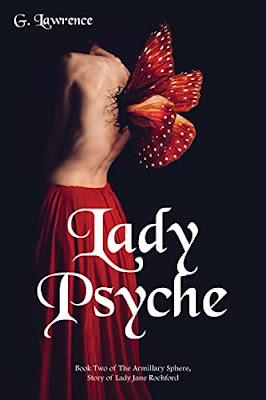
LADY PSYCHE by Gemma Lawrence

4.5 out of 5 stars


On Amazon
On Goodreads


How I discovered this book:  Been waiting for it!

In a Nutshell: Book #2 of The Armillary Sphere series, about Lady Jane Rochford

The weighty events of the King's 'Great Matter', ie his quest to divorce Katherine of Aragon and marry Anne Boleyn, are just beginning as this part of Jane Rochford's story continues; the book takes us up to Henry's break from Rome.  

My favourite aspects of this book:
  • The descriptive passages about the sweating sickness plague; it is talked about in other Tudor era books by Gemma Lawrence, but in Lady Psyche Jane tells us what it was actually like to live in a time and place when a deadly disease was rampant—a disease that was not understood, and from which few recovered.  She gives detail about how it was to live with this, on a daily basis; I was engrossed.
  • The picture painted of the 'cage' Jane was in (as described by a woman she met on a visit to Bedlam); she felt invisible and probably was, to a large extent, sitting as she did on the sidelines of the Boleyn family.  So in love with her husband and longing for a child, each day being reminded of her empty womb and her husband's indifference, and being faced with the realisation that she was not of importance to anyone.  Her fears for the future, her sanity and her soul once Henry named himself Head of the Church, and her constant loneliness.  Rarely have I seen illustrated so well how bleak was the lot of women in those days.  Put simply, she had no choice in how her life was lived.
  • How Jane has been given a slight and believable psychic ability, the occasional vision of the future.  I loved reading about the times when she saw what was to come but could not interpret it, and would have loved to see more, but on balance I think Ms Lawrence was wise to show this only sparsely.  

This is the fourth series by Gemma Lawrence in which the 'Great Matter' takes centre stage; it also features prominently in her series about Anne Boleyn (obviously!), Jane Seymour and Catherine Howard.  Each time it is told from a different point of view, which is clever, though I wonder if the accounts might benefit from a little pruning of detail, so that it remained, in this case, primarily Jane's story, rather than that of Anne, Henry, Wolsey, etc.  Having said that, the royal love triangle would have been the main topic of conversation for anyone in court circles at the time, Jane's fortunes were inextricably linked with Anne's, and ladies-in-waiting did not do a great deal apart from attend their mistress and take part in court gossip!  

I look forward to the next book, very much.


Thursday, 25 November 2021

LITTLE ROOMS by Gemma Lawrence @TudorTweep

5 out of 5 stars


On Amazon
On Goodreads


How I discovered this book: Last in a series by one of my favourite authors - automatic purchase.

In a Nutshell: The last years of of Elizabeth I

I actually missed about three of this ten book series because, you know, so many books so little time, so I thought I'd chance not knowing exactly what was going on and dive into the finale - and what a finale it was.  It's a huge achievement to have written such a detailed biography of a historical character, and must make Gemma Lawrence one of the finest authorities on the last of the Tudors.

Little Rooms opens with contemplation on old age and death, a thread that continues throughout the whole as Elizabeth looks back on her life, those she has cared for and still misses, and feels Death waiting for her in the shadows.  I loved her outlook on what it means to grow old; anyone over the age of fifty will identify with all that she says, particularly her thoughts on how she views the young, and how they view her.

Much of the book is taken up with the bizarre behaviour and treachery of Robert Devereux, Earl of Essex and stepson of Elizabeth's life-long love, Robert Dudley.  Here I was aware of the gaps in my reading, as I hadn't read about Dudley's death or her favouritism towards Essex.  Not knowing the history of the later Elizabethan period actually added to the 'page-turner' quality of this book; I couldn't wait to find out what would happen to this sly, fickle young man, what would happen in Ireland, etc.  I was most interested in the Bolingbroke and Richard II comparison, too.

In Little Rooms, Elizabeth comes across as all I've imagined her to be at this stage in her life - a wise old woman hitting out with a stick and her sharp tongue, bestowing much on those she loves, applying sense and reason to problems in the realm with great insight and a dry wit.  All of this, while wearing elaborate gowns, wigs and make-up.  In fact, 'elaborate' doesn't even go there.  See below.

It was great, but you really should start at the beginning of the series!