Showing posts with label 1930s. Show all posts

Sunday, 29 October 2023

THE LUCK OF THE DRAW by Marie Keates @marie_keates

 4 out of 5 stars

On Amazon (universal link)
On Goodreads


How I discovered this book: I've read Book #1 in this series.

In a Nutshell: A missing girl, domestic troubles, the lure of gambling and the rumblings of war

I read the first in this series, Plagued, earlier this year, and thought it was time I tried another!  The series is a continuing saga of the people who live in one area of Southampton between the two World Wars; it is their story, with the events of those tumultuous 21 years forming the ever present and always relevant backdrop.  This is Book #5, taking place during the second half of 1937.  I have a terrible memory so couldn't remember any of the characters; I can, thus, confirm that the book is a stand-alone as well as being part of a series.

The story centres around a few plot threads: the missing Sophie Morales, the mysterious activities of unsavoury Norm McCartney, and a discovery that tests tram driver Walter's greatest friendship.  I had in my mind an idea to write about how convincingly this was dealt with, but I've just re-read the blurb and realised that to do so would be a massive spoiler, so I'll just say that I thought Walter's private thoughts were so well written.  Odd sentences absolutely nailed it.

The other main storyline was that of Clara, a 20 year old young woman with an unhappy homelife, already with a broken heart.  She unsure of herself, hoping for happy-ever-afters, and so different from her more confident, outspoken best friend Gladys.

Although World War I finished almost twenty years before this story took place, it is still very much a part of all their lives.  Older character Percy made a couple of memorable statements:

'All the generals keeping nice and safe behind the lines, sending us infantrymen off to die.  They saw it as a game of chess and us as expendable pawns.'

'Anyone who saw the things we did can understand why someone would desert.  Those poor sods, just boys, some of them, were shell-shocked and terrified, but they shot them anyway ... How is that right?  Those generals issued orders without ever setting foot on the bloody battlefield.  If anyone needed shooting at dawn, they did.'

If you like wartime domestic dramas, this will totally hit the spot for you.  A very 'easy read', and it's clear how well the author knows her subject!


Monday, 14 March 2022

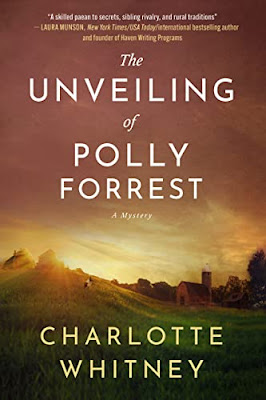
THE UNVEILING OF POLLY FORREST by Charlotte Whitney #RBRT #TuesdayBookBlog

4 out of 5 stars


On Amazon (universal link)
On Goodreads


How I discovered this book: it was submitted to Rosie's Book Review Team, of which I am a member.

In a Nutshell: Family drama/mystery set in rural Michigan during the 1930s Depression

A book about America's Great Depression always piques my interest; this suspense-filled story of sisters Sarah and Polly, living in farming country in Michigan in 1934, certainly conjured up the atmosphere.  Elder sister and vicar's wife Sarah is dutiful, industrious, a tad self-righteous and bitterly jealous of Polly;  Polly is stunningly pretty, stylish (with a penchant for glamorous hats), and newly married to the mysterious Sam.

It's clear that the author has a passion for this period of history and really understands the hardship people lived through, with no knowledge of how or when it would end, and I so appreciated all the detail of the every day lives.  As for the characters, I found that at first I sympathised with Sarah and wasn't so keen on Polly, but as more insight was given, I soon felt the other way round, and felt the claustrophobia of Polly's life, while disliking Sarah's attitude.  I very much liked how the truth about Sam and Polly emerged so gradually; a slow 'unveiling' indeed.

The book is told from the POVs of Sarah, Polly and Sarah's husband Wes; I did feel that Sarah and Wes's 'voices' were too alike, and I'd sometimes have to flick back to remind myself whose chapter I was reading.  

I didn't realise straight away that I'd read another book by this author for the review team, a while back; I refreshed my memory about it, and think this is a much more interesting novel, with a more complex and intriguing plot, though one storyline seemed superfluous - a forbidden desire that I thought was going to go somewhere exciting but just petered out, as if the author had got bored with it.  Aside from the start being a little exposition heavy, to set the scene and give background information, I enjoyed the unfolding of the story and was completely taken by surprise when the 'reveal' came - that's always a real bonus!  


Saturday, 30 May 2020

THREADS by Charlotte Whitney

4 out of 5 stars

On Amazon UK
On Amazon.com
On Goodreads


How I discovered this book: it was submitted to Rosie's Book Review Team, of which I am a member.

In a Nutshell: Family drama set in 1930s rural Michigan

Threads is a set on a farm in Michigan during the Depression, about a family struggling to survive.  The novel is told in alternating first person points of view of the three daughters: Flora, who is seventeen, Nellie, the youngest, who is seven, and Irene, somewhere in the middle.  Nellie is a tad wild, with a vivid imagination; Irene is a rather smug goody-goody on the surface, but is clearly suffering from 'middle-child syndrome', while Flora is very much the 'big sister', nearly an adult, who sees how the world works outside the concerns of the other two.  Each sister's character is clearly defined, with her own distinctive voice.

The novel is primarily concerned with the way of life of that place and time; it is character rather than plot-driven, an illustration of the family's immediate world and their fears, joys and struggles.  These people were POOR.  If you've never dined on potatoes every night, or looked on a bean sandwich as a treat, you should never think of yourself as hard-up again!  Within the girls' narratives, Ms Whitney has shown us a bigger picture of the country in the 1930s; they tell of the 'train riders'; unemployed, itinerant young men who travelled the country by stowing away on trains, begging for food wherever they stopped.  The way the community pitched in to help each other.  The fears that consumed them all; if they couldn't sell enough produce, they would lose their homes.

I found Flora's chapters the most interesting as her thoughts concerned not just her own, insular world (what happened at school, etc) but that bigger picture.  On occasion, though, Irene and Nellie's childlike viewpoints skillfully revealed much more.

If I have any criticism, it's that I would have liked a bit more actual plot; events coming to a climax and then being resolved, at some point.  There is a little mystery concerning an event from the first chapter which is not solved until the end, but I felt there were missed opportunities to make the story more of a page-turner.  However, I did enjoy it, throughout, and would most certainly recommend it as an insightful and highly readable look at this recent and still relevant time in America's history.


Friday, 26 January 2018

A HANDFUL OF DUST by Evelyn Waugh

5 GOLD stars

On Amazon UK
On Goodreads


How I discovered this book: it's an old favourite of mine, without doubt in my all time top ten. I took it out for another re-read and just wanted to share its brilliance with you.

Genre: 1930s drama, about love, loss, social climbing... funny, tragic and poignant.

Both written and set in the early 1930s, this wonderful novel shows a world that scarcely exists anymore.  Tony Last and his wife Brenda live at the Last family seat, Hetton Hall.  Theirs is a world of guests coming up to the country for the weekend, of running a house on a full staff at a time when the age of huge country houses is coming to an end.  Tony wants only to live the life of a quiet gentleman, but Brenda yearns for the social life she once enjoyed in London. 

On one particular weekend Tony forgets that, over a drink at one of his clubs in London, he invited a young man called John Beaver to stay.  Although Beaver's visit is not welcomed by either of the Lasts, Brenda finds him oddly enchanting.

Beaver is an impoverished social climber who lives with his mother, a busy-body interior designer.  Anxious to improve his position in Society, he accepts any invitation going.  When Brenda falls in love with him he sees a way to push himself forward.  Under the pretence of doing a course in economics, Brenda takes a small flat in London, leaving Tony in the country, unhappy, alone, but completely in the dark about the affair.


Brenda and Beaver in the film that was made of the book; it's okay, but doesn't do it justice.


A family tragedy brings matters to a head, and both Brenda and Tony's worlds are forever changed, with Tony uncharacteristically heading off on a South American jungle expedition, simply because he does not know what else to do.

This book is such a delight.  Each social class is portrayed with great wit, from the impoverished aristocracy, to the socially ambitious, to the young women of the night to be found in the 'lousy joint' that Tony and his friend Jock visit on occasion.  It's a cracking story, with far more to it than just a broken marriage, but I also loved the more subtle elements, such as the passages that show Tony's love for his home, the only place he wants to be.  You will love Tony and want to cry with him for the way he is treated, though he does exact certain justified revenge.  It's a perfect book, and everyone who appreciates fine, gently satirical literature of this time should read it.


Tony with his and Brenda's son, John Andrew

Monday, 22 December 2014

1923 A MEMOIR by Harry Leslie Smith

5 out of 5 stars

Non Fiction, Memoir, 1920s, 1930s, WWII

Originally posted on Amazon HERE on 18 November 2012


This memoir of Harry Smith's early life in the poverty-stricken north of England was gripping, from the start - a short history of his family and how he came to be born into the situation he did - to the end, which was an account of the war from an average Joe's point of view.

I liked the early part best - it's so hard to believe that such hardship could have existed in this country, in the the last century, not so many years before I was born. I found the perceived difference between the starving north and the wealthy south most interesting, too. I kept being amazed over and over again that so many people had to live in the way they did, before the Welfare State. I know we all know about such things because we've been told about them, but to read someone's personal account of such a life brings it homes much more soundly.

I was engrossed in this book and read it very quickly - when the Kindle started saying '92%', and upwards, I was thinking, no, no, I want to read more! Better go and buy the next one, then....

Highly recommended, fascinating.