Showing posts with label WW1. Show all posts

Monday, 8 September 2025

BEELITZ-HEILSTÄTTEN: Where Ghosts Never Die by Marina Osipova @marosikok #RBRT

 4.5 out of 5 stars


On Amazon (universal link)
On Goodreads


How I discovered this book: it was submitted to Rosie's Book Review Team, of which I am a member.

In a Nutshell: Timeslip terror, Pandora's Box opened...

A most interesting and unusual book.  Obsessed with seeing the place of her birth, a ghostly, derelict German military hospital near Berlin, Marion has no idea what will happen to her once she is inside, and what she will uncover, later.

I loved the timeslip element of this story, with Marion travelling back in time to the First World War, and finding herself working at the hospital as a nurse, tending to the injured men.  One in particular sends shivers of repulsion through her, though she doesn't know why; I liked how Ms Osipova endowed her with vague recollections about her life before, frustrating to her.  She knows something about various people, various elements of her life, but not what those 'somethings' are.  In the case of this patient, we know who he is, but Marion does not.

There are other truths to uncover about her present day life, as age-old documents are unearthed and she seeks the horrifying truth about the handsome young doctor she fell in love with during her dip back into the past, before the mind virus of Nazi Germany infected so many previously sane people.

This book is gripping, masterfully atmospheric, and unpredictable throughout - I thoroughly enjoyed it.


Monday, 10 June 2024

SIDESTEPS TO THE SOMME by Valerie Poore @vallypee

 5 out of 5 stars


On Amazon (universal link)
On Goodreads


How I discovered this book: I've read lots of this author's books, so, with my own interest in WW1, this was an obvious choice!

In a Nutshell: Travels by barge along the Western Front, with Val and her other half, Koos.

Sometimes I wish Val Poore's books had photos, though more than anyone else, the way in which she writes makes one able to 'see' the places, and certainly feel the atmosphere.  As ever, this book made me long to travel down those little side canals (I'm sure I'd be 'sidestepping' all the time, too!), off the beaten track, as it were.  A perfect way to live.

There were so many lovely tales in this book, one of my favourites being Koos and Val's impromptu musical session in a disused factory.  Koos is fascinated by derelict industrial sites and is a fine photographer - I too have a strange attraction to the derelict and abandoned, so I looked up some of his photos on YouTube via his unused TwitteX profile; they're HERE, if you would like to see.

Best of all, though, when browsing his YouTube profile I happened across this gem - I thought, hang on, I just read about this!  It's a lovely piece of music - oddly mournful, made me think of peasants dancing in a Polish village, decades ago (for some reason).  


Back to the book ... another passage that stood out for me was Val's visiting of some of the WWI graves.  She remarked on how the German dead were commemorated there too - because, of course, those poor boys and men weren't the enemy at all.  That label belongs to the generals, bankers and industry moguls whose own greed and megalomania caused the deaths of so many, for ... nothing much at all, really.  Talking of which, I loved Val's comment about Napoleon's aptitude and foresight when it came to building the canals of France - that he should have been an engineer, not a megalomaniac.

At the end of this piece in the book, Val was joined by a grey mare, who stood there and silently contemplated the graves, with her.

It's a beautiful book about a beautiful two months.  Informative, wistful, entertaining - a delight.


Sunday, 21 January 2024

ALL QUIET ON THE WESTERN FRONT by Erich Maria Remarque

 5 GOLD stars


On Amazon (universal link)
On Goodreads


How I discovered this book: Looked for it after re-watching the recent German remake of the film

In a Nutshell: A young German man's experiences in World War I

I was surprised, when I started to read this book.  I expected it to be heavy going, a lengthy tome, but it's far from that.  It's not very long (I would estimate about 70K words), and the first person point of view of Paul Bäumer, the protagonist, flows along in a highly readable fashion; it's like reading a diary.  I'd finished it in just two days, couldn't put it down.  

It goes without saying that the novel illustrates the absolute evil of war, and reminds one of the pointlessness of all that those millions of poor men suffered on the Western Front, for nothing much at all apart from making those who profit from such carnage even richer and more powerful.  Meanwhile, Paul and his friends gradually change from enthusiastic lads who were lied to by their teachers about the glory of war and how it was their duty to enlist, to shell-shocked and lost men who can relate only to each other; nothing prepared them for the horror of trench warfare, and no words can explain it to those back at home.

Echoing the cover, it's just the best war novel I've ever read.  Read it!! (btw if you're buying off Amazon, be careful not to get an abridged version)

'I am twenty years of age but I know nothing of life except despair, death, fear,  and the combination of completely mindless superficiality with an abyss of suffering.  I see people being driven against one another, and silently, uncomprehendingly, foolishly, obediently and innocently killing one another.  I see the best brains in the world inventing weapons and words to make the process that much more sophisticated and long-lasting.  And watching this with me are all my contemporaries, here and on the other side, all over the world - my whole generation is experiencing this with me.'


This picture says so much, no matter which country's generals demanded you be sent off to kill and be killed by men just like you - the Cameron Highlanders, before and after WWI.


Monday, 8 January 2024

THE DRAU RIVER FLOWS TO SIBERIA: The Victims of Victory by Marina Osipova

5 out of 5 stars


On Amazon (universal link)
On Goodreads


How I discovered this book: it was submitted to Rosie's Book Review Team, of which I am a member.

In a Nutshell: The story of two people who survived Stalin's Siberian gulags, and the fate of the Cossacks under the care of the Allies in WWII.

I feel quite exhausted having just finished this book, a lengthy novel in which I was engrossed throughout.  It centres around what happened to anti-Soviet Russian nationals at the end of WWII - mostly the Cossacks of Ukraine and other 'enemies' of the Allies - at the hands of the victors: the British and Americans as well as Stalin's Red Army, who also assured Germans that they would remain in the hands of the Western Powers.  All in the name of 'repatriation'. 

Anna and Zakhary, finally set free from incarceration under the most brutal of regimes, are strangers who meet by chance on an isolated peninsula of the Ob River, in 1955.  While waiting many hours for a boat, they tell each other their stories, immediately taking the reader back to the end of the war and the unforeseen dangers that lay along the paths they were about to walk.  

Zakhary was a German national whose Cossack father had taken his family to live in Germany.  Anna found herself separated from her family when the Wehrmacht occupied her town, and was offered the chance to work in Germany; sadly, she believed lies about what a good move this would be.  At the end of the war, though, she finds that nothing she experienced in the last few years has prepared her for what is to come.

The slippery hand of fate takes both of them to the Siberian Gulags; although this is fiction, you cannot help but be aware, throughout, that everything Anna and Zakhary went through was experienced by hundreds of thousands, many of whom would never see freedom again.

This isn't just about the evils of Communism, or of war, but man's inhumanity to man.  My only (tiny!) complaint is the occasional use of American English.  Words like 'normalcy' 'cookies' and 'fall' (rather than autumn) never sit right with me when the book is about European or Eurasian people.  But I doubt anyone will mind that as much as I do, if at all, and this really is a terrific book.

Here is an article about the Lienz massacre in Austria, in which the Cossacks were betrayed by the British army, and another one HERE.  Below, a short video.


Sunday, 29 October 2023

THE LUCK OF THE DRAW by Marie Keates @marie_keates

 4 out of 5 stars

On Amazon (universal link)
On Goodreads


How I discovered this book: I've read Book #1 in this series.

In a Nutshell: A missing girl, domestic troubles, the lure of gambling and the rumblings of war

I read the first in this series, Plagued, earlier this year, and thought it was time I tried another!  The series is a continuing saga of the people who live in one area of Southampton between the two World Wars; it is their story, with the events of those tumultuous 21 years forming the ever present and always relevant backdrop.  This is Book #5, taking place during the second half of 1937.  I have a terrible memory so couldn't remember any of the characters; I can, thus, confirm that the book is a stand-alone as well as being part of a series.

The story centres around a few plot threads: the missing Sophie Morales, the mysterious activities of unsavoury Norm McCartney, and a discovery that tests tram driver Walter's greatest friendship.  I had in my mind an idea to write about how convincingly this was dealt with, but I've just re-read the blurb and realised that to do so would be a massive spoiler, so I'll just say that I thought Walter's private thoughts were so well written.  Odd sentences absolutely nailed it.

The other main storyline was that of Clara, a 20 year old young woman with an unhappy homelife, already with a broken heart.  She unsure of herself, hoping for happy-ever-afters, and so different from her more confident, outspoken best friend Gladys.

Although World War I finished almost twenty years before this story took place, it is still very much a part of all their lives.  Older character Percy made a couple of memorable statements:

'All the generals keeping nice and safe behind the lines, sending us infantrymen off to die.  They saw it as a game of chess and us as expendable pawns.'

'Anyone who saw the things we did can understand why someone would desert.  Those poor sods, just boys, some of them, were shell-shocked and terrified, but they shot them anyway ... How is that right?  Those generals issued orders without ever setting foot on the bloody battlefield.  If anyone needed shooting at dawn, they did.'

If you like wartime domestic dramas, this will totally hit the spot for you.  A very 'easy read', and it's clear how well the author knows her subject!


Sunday, 19 February 2023

PLAGUED by Marie Keates @marie_keates

4 out of 5 stars


On Amazon (universal link)
On Goodreads


How I discovered this book: Twitter

In a Nutshell: WW1 soldier is invalided home after injury, only to face a feeling of alienation - and the Spanish flu epidemic.

An emotional family drama about one of the hardest times in the 20th Century, Plagued tells the story of Thomas, a soldier who gets a 'Blighty wound' during his time at the front during the last year of World War I.  Having changed in every way from the man who left so joyfully in 1914 - he and his friends thinking that they were setting off on glorious, honourable adventure - he finds integration back into 'normal' life beyond difficult.  Like his friends, he doesn't want his wife to know how hellish the war actually was, but at the same time feels alienated because he has been through appalling experiences that he can't talk about.

This is also the story of Thomas's wife Mary and her many friends who face the hardship of civilian life during a war, of fear that their husbands, sons and brothers will not come home, and finally of the Spanish flu that felled so many at that time.

This is a highly readable book and I looked forward to getting back to it each time I put it down.  So many aspects of the time are dealt with, and the research is evident without being intrusive.  I did have trouble remembering who was who in the large cast of characters - who was married to whom, which children belonged to which mother, but this didn't really matter.

I particularly liked the ending, in 1919, when Thomas and some friends stand by the site of the future cenotaph; it had a sadly poignant ring to it.  If you like wartime family dramas, you'll love this.


Thursday, 13 January 2022

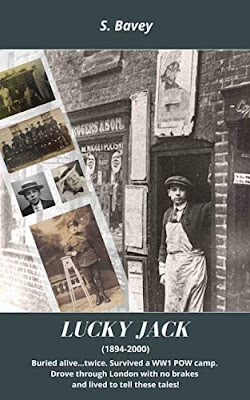
LUCKY JACK by S Bavey @SueBavey

 4 out of 5 stars


On Amazon (universal link)
On Goodreads


How I discovered this book: via Rosie Amber's Review Blog

In a Nutshell: A biography of Sue Bavey's paternal grandfather, though written in Jack Roger's first person voice.  He and Sue were very close.

This is such a great project to have undertaken; Sue says she wanted to get Jack's story down for her own children, and generations to come.  

It's a charming book, starting with London life in the late Victorian times - Jack was one of those rare people who have actually lived in the 19th, 20th and 21st centuries.  At one time he was officially Britain's oldest man, and at the age of 103 co-wrote a column for the Lincolnshire Echo for a while.

Although this memoir covers some tragic times, such as the two world wars, it is mostly kept to a lighthearted vein, though I have to say that the section I found most memorable was his time in a German POW camp during WW1, when he and his friends suffered hardship we cannot even imagine in these times.  I also found the chapter about living in the flight path of Heathrow Airport oddly poignant; he talks of a time before, when seeing planes take off was a novelty for him and his wife, only to find, later, that living in its immediate vicinity was no joke.  I felt sad to think of the pub he loved which, of course, disappeared under all that concrete.

An interesting surprise for me was that Jack opened his surgical boot making business in 1920, at a premises in Goldhawk Road, Stamford Brook, which is in Hammersmith, North London.  My mother was born in 1926 and, until the late 1940s, lived in her family home in Vaughan Avenue, Stamford Brook - which happens to be just off Goldhawk Road - I looked up a street map of the area.  So Mum must have known of Jack's shop; she may have even met him!  Small world indeed.

(Note 18 Jan:  She did, and more!  Please see HERE for the stuff I found out.)

The secret of Jack's long, healthy and lucky life seems, from what I read in this book, to have been his positive attitude and adaptability, taking the enormous changes in the 106 years of his life in his stride.  We can only imagine what it must be like to have seen so, so many changes in the world.  I bow with respect.


Tuesday, 20 July 2021

SUNFLOWERS UNDER FIRE by Diana Stevan #RBRT

4 out of 5 stars


On Amazon UK
On Amazon.com
On Goodreads


How I discovered this book
: it was submitted to Rosie's Book Review Team, of which I am a member.

In a Nutshell: Fictionalised biography, early 20th Century Ukraine.

Even before I began to read this, I was so impressed by what Diana Stevan has done - this is the first part of a partially fictionalised biography of her grandmother, Lukia Mazurets, who Stevan knew as a young child.  In the notes at the back, she writes that her mother told her the story of their lives, and she pieced the rest together by extensive research of the history of that place and time.  The research is evident throughout, without seeming intrusive; the customs and daily toils of such resilient peoples' lives were fascinating to read about.  Also most interesting was the effect of the political situation, from WW1 to 1929, and how little the peasants actually knew; all news about events elsewhere in the country came via word of mouth.  Aside from this, the nature of Lukia's incredibly hard life, with so much tragedy, meant that events happening thousands of miles away were not her immediate concern. 

The novel begins in 1915, with her husband going off to fight for the Tsar just as Lukia has given birth to a sixth child - Stevan's mother.  The story is simply written, very readable, and I flew through the first half.  During the last third, I sometimes felt that events were whizzed through too fast, and the storytelling became a little too simplistic, as if she was racing to the end. Now and again I would have liked a little more depth and detail, and did consider that there might be an excess of material for one novel.  

In itself this is a marvellous book to have written, and I imagine it is greatly treasured by Stevan's family, but it also stands up as commendable piece of historical fiction about the lives of the common people of a country about which I knew little.  I have the sequel, and look forward to finding out what happens next.


Friday, 26 February 2021

THE HEART STONE by Judith Barrow

5 out of 5 stars


On Amazon UK
On Amazon.com
On Goodreads


How I discovered this book
: I've read most of the author's other books, and was looking forward to this one.

In a Nutshell: Family/romantic drama set during World War I.

Jessie: sixteen years old, with a revolting stepfather and the boy she loves going off to war ... the stage is set.  I was thoroughly engrossed in this book all the way through, looking forward to getting back to it each time.  The aforementioned revolting stepfather, Amos Morgan, was so despicable that I was hoping for his comeuppance all the way through the first section of the book, and don't get me started on Bob Clegg....

What struck me most, throughout, was how hard life was for women in those times.  I questioned, now and again, why Jessie put up with all that she did, but you can't judge a woman of the second decade of the 20th century by even the standards of a woman, say, in the 1950s.  Especially not one who is poor, and not that well educated.  Then there's the First World War propaganda that sent all those young men off to almost certain death, and made them feel guilty when they didn't want to go—one of the biggest crimes against humanity in history.  Not to mention the fate of deserters. Words fail me.

My favourite characters were Clara, Jessie's educated, progressive friend, and Arthur, Jessie's love who went to war.  The chapters written in his point of view were stunningly good; Ms Barrow portrayed his haunted, disturbed mind so well. Although her main characters are usually female, it's her male characters that are often the most memorable—Bob Clegg's dialogue was masterful.  

This is definitely my favourite, all round, of all the books by Judith Barrow that I've read.  Previously, my favourite was A Hundred Tiny Threads, which tells me I like her historical fiction the most.  I think it's because her settings and characters are all northern working class of the, 'aye, love, I'll put the kettle on when you've filled the coal scuttle and boiled the cabbage for our tea, and that Ada Bloggs over t'road is no better than she ought to be' type, which I find slightly depressing in more modern times, but, pre-World War II, it's far enough away not to be so!

As with most books there were odd occasions when I was a little frustrated by a development, but much of this is just personal taste—if domestic wartime dramas are your thing, I guarantee that you will love this book!


Monday, 11 January 2021

The Other Mrs Samson by Ralph Webster #RBRT

4 out of 5 stars


On Amazon UK
On Amazon.com
On Goodreads


How I discovered this book: it was submitted to Rosie's Book Review Team, of which I am a member. 

In a Nutshell: Family drama covering WW1 and WW2

This book, for me, went from nicely readable and moderately interesting, to absolutely unputdownable, and back to moderately interesting.  The first narrator, in the present day, finds a secret horde of papers belonging to his recently deceased, ninety-five-year-old friend Katie Samson, from which he surmises that her husband had been married before.  At this point, although not enthralled, I thought, well, this is certainly no chore to read, being nicely written and with the possibility of a great story to come.

...and whoosh, there it was. I turned the page to the POV of Hilda, the first wife, and the book bloomed, opened up, emerged from black and white into glorious technicolour.  Hilda's story went back as far as her grandparents' experience in San Francisco Gold Rush days, and on to the making of that city, the role of women in the Victorian era, life in a small Bavarian village, changing times and growing problems in Europe, to do with Germany's place in the world - I was gripped, all the way through.  Hilda and her grandmother were so alive, and aside from being a great story with wonderful characters, it was historically informative.  Fascinating.  Loved it.

Next came Katie's POV, and at first I still liked it a lot, as I read about her family tragedies, the aftermath of WW1 and Berlin's 'Roaring Twenties', the effects of American's Great Depression on the rest of the world, the Nazi party's growing control, and her and lover Josef's route out.  Then the lead up to the WW2 ... and I'm afraid it all went a bit flat for me, lacking in emotion.  The threat to Josef, a Jew, was described as 'very unsettling';  I read of an escape into the woods when Nazis arrive at their door, and their luck at being able to move from one place to another just in time, before the Gestapo established travel restrictions, but there was no drama or sense of danger.  Hilda told her own highly compelling story with the history as the backdrop, as did Katie at first, but the latter part felt impersonal, as though she was just listing events.

I was disappointed by my disappointment, if you know what I mean, because I loved the book so much earlier on; for instance, Katie's only brother, Karl, joins the Nazi party and gains a position of authority, but that's all—we never hear about him again; I'd hoped for a storyline about this.  There was a twist at the end, but it felt a little rushed.  

Four stars on Amazon because Hilda's part was absolutely 5* plus, and because the author writes in an extremely accessible fashion, so that even the parts I liked less were no effort to read.  I would recommend it to readers who like a family drama and are interested in reading about the history of the times mentioned - and it's worth getting just for the middle section.

Tuesday, 16 January 2018

FRED'S FUNERAL by Sandy Day @sandeetweets

4.5 out of 5 stars

On Amazon UK
On Amazon.com
On Goodreads


How I discovered this book: it was submitted to Rosie Amber's Book Review Team, of which I am a member.

Genre: Family drama, history

Fred's Funeral is a long novella, beginning with the death of Fred Sadler, in 1986.  As he dies, his ghost floats up and observes his relatives at his bedside, and follows them to the funeral and back to his family home as they share their memories of him.  The book then dips back and forth between present and past, to his childhood in Jackson Point, near Toronto, to his horrific experiences in the First World War, to the many years afterwards when he was trying to find his feet.

Fred led a difficult life, always the outsider.  His family history is complicated, with many undercurrents, resentments and complex issues.  Little went right for him after WW1, which was, of course, closely followed by the Depression.  He suffered from shell shock for many, many years, but this was not understood in those days; his family tried to get him a disabled war veteran pension, or into a hospital for those who suffered with this malady, but they were to discover that the doctors were in cahoots with the military: if a patient was diagnosed with a different sort of mental illness, the War Office would not have to pay.

Fred is diagnosed with schizophrenia, and goes through much in the various hospitals he is sent to.

As Ghost Fred watches his family, he feels in turn angry, misunderstood, unloved and, occasionally, pleased by what he hears.  He was thought of as 'mad old Fred', and there is much in this book that is so sad; it made me want to find the younger man and make everything alright for him.  As the book dots about between times, I kept being lifted out of one era and put down in another but they fit together nicely, I became quickly engrossed in every snapshot of his life, and gradually the jigsaw fitted together.

The book is so readable and well written, and I enjoyed how the story built up, not only in Fred's life but from a sociological history point of view.  It's interesting (if frustrating) from the point of view of family wrangles, and builds such a tragic picture of the poor men caught up in the pointless carnage of WW1.  I really liked it.


Tuesday, 22 August 2017

A HUNDRED TINY THREADS by Judith Barrow @barrow_judith

4.5 out of 5 stars

On Amazon UK
On Amazon.com
On Goodreads

How I discovered this book:  I'd read the rest of this series and was looking forward to this prequel.  I highly recommend the short stories attached to the series, Secrets.

This is the fourth book in the Pattern of Shadows series, though in some ways the first, because it's the prequel to the others, which are set in the 1940s, 50s and 60s.  I'd recommend reading it first, anyway.  It spans the years 1911 to 1923, and tells the story of earlier members of the Howarth family.

So, there was me thinking this was going to be an 'eh-up, love, put the kettle on' family drama amongst the cobbles, with a bit of WW1 angst thrown in.  I was wrong; it's so much more than that, and far more interesting.  The book starts with Winifred Duffy, daughter of 'orrible Ethel, joining up with some enchanting Irish scallywags with irritating dialogue tics who are involved in the fight for the women's vote.  The story was jogging along in a modest fashion, until (enter stage left) along came Winifred's grandmother, Florence, who I loved, and whose story was heartbreaking.  A moment later I was reintroduced to Bill Howarth (Mr Prologue), a thoroughly unlikeable character who grew increasingly despicable, and all of a sudden I realised I was engrossed.  I do love a well-written nasty piece of work, and Judith Barrow has done a masterful job with Howarth.  He'd had a bad start in life, yes, but I didn't pity him; my loathing of him grew more intense as the book progressed.

The saga moves through the treatment of the suffragettes, lost love, unwanted pregnancy, dark family secrets, the evil, pointless horror of WW1, the general godawful fate of the impoverished classes, the 1919 influenza epidemic, the atrocities committed by the Black and Tans ~ this is no rose-tinted piece of nostalgia, and no detail is spared.  Saddest of all is the life of Winifred, in many ways; although she finds some degrees of happiness, the theme all the way through seemed to be how women of the time had to put up and shut up, and accept what they got, even if it was so much less than they deserved.  This aspect of the book is so well done, without being hammered home.  I was pleased that, although there was resolution, there was no great happy ending.  100 Tiny Threads is about real life, and quite an eye-opener it is too; it made me glad I wasn't born fifty years earlier, for sure.

When I got to the end, I wanted to nip back to Pattern of Shadows, set in WW2, to find out what happened to Bill and Winifred; it's two or three years since I read it, and I can't remember.  D'you know, I think I will.

Thursday, 22 June 2017

SECRETS by Judith Barrow @barrow_judith

4.5 out of 5 stars

On Amazon UK
On Amazon.com

How I discovered this book: I've read the three books in Judith Barrow's Howarth family saga, so was interested to read this offshoot collection of short stories. **Only 99p**

I read the whole collection this afternoon, and really enjoyed them.  Each story deals with a character who has a secret; the first few are quite short, the longer, more involved ones nearer the end.  I recognised some of the names from the series, but it wouldn't matter if I had or not; they're all terrific stories in their own right.  The best ones are, I think, Alun Thomas and Stan Green's secrets, both of which are heartrending and take place during the First World War; I imagine I will meet these two when I read the prequel to the trilogy, which is out this summer. 

What the characters have in common is their social class, and the book is a great illustration of how some situations caused great trauma for the subject, yet wouldn't matter at all today, or even occur; a boy of fourteen lies about his age and signs up to fight in the war, a girl survives a mother and baby home where the children are taken away for adoption, a battered wife has no choice but to stay with her husband.  The characterisation is spot on, all the way through.

Judith Barrow has done a great job of ending some stories with dangling threads, leaving you dying to know what happens next ~ thus, the outtake short story collection for a series.  It certainly worked for me!  But they stand up perfectly well on their own.   I definitely recommend them for a great couple of hour's reading.

Tuesday, 23 December 2014

THE ONE AND SIXPENNY ENGLISHMAN by Harry Bergman and others

4 out of 5 stars

Non fiction, memoir, 20th century


On Amazon UK HERE
On Amazon.com HERE


Well, this was a nice little morning's read! I love reading true accounts of ordinary people from the early part of the 20th century; what always strikes me is how they accepted hardship and got through it the best way they could, with none of today's attitude of entitlement. Harry Bergman led a fascinating, full life. One thing I liked reading about was his entrepreneurial side; it's no secret that soldiers who came back from WW1 were treated appallingly by the establishment for which they had offered their lives, but Harry didn't sit back and complain, he just got on and made money in whichever way he could.

The photographs in the back of the book were lovely to look at, and made it all mean so much more.


Wendy Janes, Harry Bergman's grandaughter as named in this book, has contributed to anthology A KIND OF MAD COURAGE, reviewed HERE

Monday, 22 December 2014

THE ABSOLUTIST by John Boyne

5 GOLD STARS

WWI, Drama

Originally reviewed on Amazon HERE on 25 February 2012


I adore John Boyne, and his most recent work is one of my favourites. I love anything set in WW1, and this has shown me all sorts of other sides to what happened to families and individuals through those years. It's one of the most beautifully written books I have read. I won't say "I couldn't put it down" because I made myself; I rationed myself with it because I didn't want it to end. You know how when you've finished a particularly wonderful book you don't know quite what to do with yourself and wonder what on earth you're going to read next? I'm still wondering..