Sunday, 10 April 2022

WHY ODIN DRINKS by Bjørn Larssen #RBRT #TuesdayBookBlog

4 out of 5 stars


On Amazon (universal link)
On Goodreads


How I discovered this book: it was submitted to Rosie's Book Review Team, of which I am a member.

In a Nutshell: A Norse God with Imposter Syndrome...

I read the first episode of Bjørn Larssen's (very) alternative Norse mythology, Creation, which is now incorporated into this book - this is good, because I was able to re-read it before embarking on the confused All-Father's further adventures.

I think I would need to know a lot more about Norse mythology than I do in order to fully appreciate this, though I did look up bits and bobs here and there, which helped.  The idea of portraying Odin as rather hesitant and not quite sure of his role as ultimate creator, is inspired.  Problem is that he and all the other gods (and versions of Odin in the past, present and future) know about everything that will be (which seems logical, what with them being deities), but are not always sure whether items or concepts actually exist yet.  Like Odin's wife Frigg not being sure what a miniskirt is, but knowing she wants one. 

'What sort of tea will you have?'
'They haven't discovered it yet,' said Urðr.  'He looks like the lapsang souchong type to me, though.'

One of my favourite aspects was the occasional presence of 'literature'.  She is an entity that whispers to Odin's mind a piece of information pertaining to something that has just been said, such as 'Loki is foreshadowing', but Odin cannot see her; he just hears the sound of her sneakers as she sprints away.  I love that.

In parts 2-4 we meet many more gods - Loki, Freya and Freyr, and Frigg.  Freya, goddess of love, beauty, fertility, sex, war and gold (pretty much all the most important things to a Norseman, one imagines) is portrayed as a sort of Paris Hilton type, which I thought was genius.

'As he travelled, Odin thoroughly investigated people of all shapes and sizes, casually letting it slip that he was the All-Father'.

Some of the time the references went over my head because of my lack of knowledge of the subject, though other times I felt the prose needed a bit of tightening up; it seemed to career away with itself now and again.  However, the good is very very good, and I also liked the pertinent observations about life and death, time and war, woven amongst the ridiculousness.  And the ending.  Clever.

A light-hearted romp through Norse mythology, and a fitting development for Bjørn Larssen's comedic talent!


I laugh every time I look at this - the grinning Odin doing a thumbs up!


Monday, 4 April 2022

RIZZIO by Denise Mina #RBRT #TuesdayBookBlog

5 out of 5 stars


On Amazon (universal link)
On Goodreads


How I discovered this book: it was submitted to Rosie's Book Review Team, of which I am a member.

In a Nutshell: Novella about Mary, Queen of Scots

The first word that came to mind when I was thinking how to describe this book was 'enchanting', though the story itself is the very opposite.  The way in which it is written, however, is a delight indeed, even down to the off-the-wall chapter headings.  The shocking story of the murder of David Rizzio, servant, advisor and friend to Mary, Queen of Scots, bounces along in page-turning fashion, with a whisper of almost humorous cynicism as the author narrates the appalling events of the few days in question.

It is a chilling irony that the hornéd demons who stormed the Queen's apartments in Holyrood Palace claimed to be motivated partly by divisions in the Christian church - this grisly moment in history could have come straight from an anthology entitled 'The Devil and his Work'.  Also that the unborn child the demonic lords were so keen to write off actually became James VI of Scotland and James I of England - named by Elizabeth I as her successor.

Spoiled wastrel Lord Darnley - Mary's husband who threw his toys out of his pram when he didn't receive his 'Crown Matrimonial' (the sharing of the reign and the authority to rule in his own right if he outlived her) - was beautifully portrayed, while background information about the activities of his father and some of the other lords who took part in the brutality sent a chill up my spine that remains with me.  This novella brings home what a wild, dark and dangerous place 16th Century Scotland was - every scene is atmospherically perfect, and one is given the feeling that in aristocratic and 'noble' circles, one's life was hanging by a thread pretty much all the time.  

I loved what Denise Mina did with the insane Henry Yair, and the 'afterwards' section, when we read what happened to Mary in the years to follow and, most interesting of all, what happened to the Queen's apartments at Holyrood Palace.  Fascinating.  I have to look up more about this!

Excellent.  Loved it.

Monday, 28 March 2022

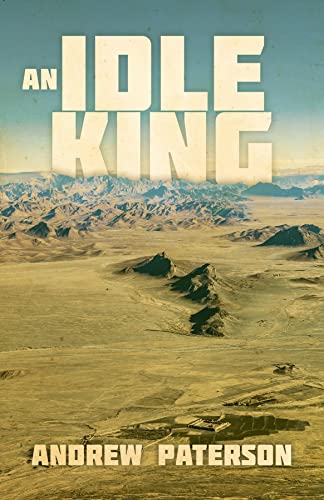
AN IDLE KING by Andrew Paterson #RBRT #TuesdayBookBlog

4.5 out of 5 stars


On Amazon (universal link)
On Goodreads


How I discovered this book: it was submitted to Rosie's Book Review Team, of which I am a member.

In a Nutshell: Military drama set mostly in Afghanistan

'An Idle King is a modern retelling of an ancient story about lost soldiers who can never go home.'

Callum King, a former army officer, is trying to come to terms with civilian life, including family difficulties and the depressing veterans' meetings.  Following news about one of his soldiers who was involved in the incident that led to Callum's discharge, he joins a team employed by a private security company, going back into Afghanistan for a chaotic, dangerous and mysterious mission.

That the author has a military background is clear from this book, not only in the practical detail but the way in which he describes the emotional state rigours of his characters.  The book is extremely well-written and certainly kept me turning the pages; Andrew Paterson has a good deal of understated talent.

The secondary characters are a fairly stereotypical bunch that one would expect in a story of this genre, whether in a book or a film - the naïve newbie, the brute, the big fatherly guy who doesn't talk much, the one female officer who becomes his right-hand-woman, the psychological wreck ... but because they're so well-drawn they didn't feel clichéd at all.  Callum himself is complex and confused; although the book is written in the third person, it still manages to show us inside his and others' heads rather than coming from a detached, omniscient narrator.

The revelation about the true nature of the mission comes as a shock to the reader as well as to Callum - it says a lot about this world, and none of it good.  There were so many quotes I loved, that spoke about the wider world as well as the country that Paterson clearly has great feeling for:

'Your people have been coming here for thousands of years trying to conquer our country.  You might as well throw sand against a mountain.'

'Habs spots a caravan of Kuchis trundling along the dried out riverbed ... mostly men in long wool coats, shepherding goats and sheep.  But some women, too, riding on the backs of camels or walking with small children in their arms ... together on some ancient migration, following routes seared deep into their forgotten histories.'

'Nation states are finished.  The future is the market state.  Instead of parliament and politicians, now the world's run by hedge fund managers and venture capitalists.'

'Callum knows all these men even though he hasn't met them before ... the scars on their faces, the missing limbs, the suffering in their eyes.  They're the children of war, soldiers in name only.  Boys who grew up without fathers.  Boys who were handed a rifle or the trigger to an improvised explosive device by old men who live far away ... and when the old men were finished with them, they were tossed aside like spent shell casings.'

'They're two old soldiers who went away to fight wars in far off places started by fat men for petty reasons.'

The ending is one of those that offers some resolution but not too much; it's sad and kind of mournful, but so right for the story.  It really is a very good book; I'd most definitely recommend.


Monday, 14 March 2022

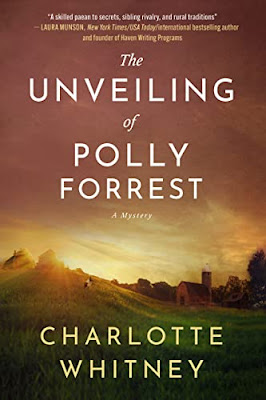
THE UNVEILING OF POLLY FORREST by Charlotte Whitney #RBRT #TuesdayBookBlog

4 out of 5 stars


On Amazon (universal link)
On Goodreads


How I discovered this book: it was submitted to Rosie's Book Review Team, of which I am a member.

In a Nutshell: Family drama/mystery set in rural Michigan during the 1930s Depression

A book about America's Great Depression always piques my interest; this suspense-filled story of sisters Sarah and Polly, living in farming country in Michigan in 1934, certainly conjured up the atmosphere.  Elder sister and vicar's wife Sarah is dutiful, industrious, a tad self-righteous and bitterly jealous of Polly;  Polly is stunningly pretty, stylish (with a penchant for glamorous hats), and newly married to the mysterious Sam.

It's clear that the author has a passion for this period of history and really understands the hardship people lived through, with no knowledge of how or when it would end, and I so appreciated all the detail of the every day lives.  As for the characters, I found that at first I sympathised with Sarah and wasn't so keen on Polly, but as more insight was given, I soon felt the other way round, and felt the claustrophobia of Polly's life, while disliking Sarah's attitude.  I very much liked how the truth about Sam and Polly emerged so gradually; a slow 'unveiling' indeed.

The book is told from the POVs of Sarah, Polly and Sarah's husband Wes; I did feel that Sarah and Wes's 'voices' were too alike, and I'd sometimes have to flick back to remind myself whose chapter I was reading.  

I didn't realise straight away that I'd read another book by this author for the review team, a while back; I refreshed my memory about it, and think this is a much more interesting novel, with a more complex and intriguing plot, though one storyline seemed superfluous - a forbidden desire that I thought was going to go somewhere exciting but just petered out, as if the author had got bored with it.  Aside from the start being a little exposition heavy, to set the scene and give background information, I enjoyed the unfolding of the story and was completely taken by surprise when the 'reveal' came - that's always a real bonus!  


Wednesday, 2 March 2022

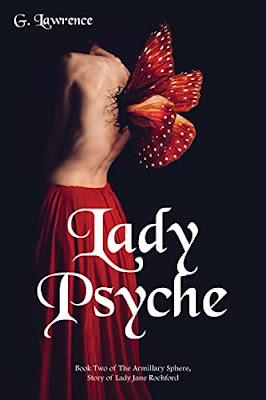
LADY PSYCHE by Gemma Lawrence

4.5 out of 5 stars


On Amazon
On Goodreads


How I discovered this book:  Been waiting for it!

In a Nutshell: Book #2 of The Armillary Sphere series, about Lady Jane Rochford

The weighty events of the King's 'Great Matter', ie his quest to divorce Katherine of Aragon and marry Anne Boleyn, are just beginning as this part of Jane Rochford's story continues; the book takes us up to Henry's break from Rome.  

My favourite aspects of this book:
  • The descriptive passages about the sweating sickness plague; it is talked about in other Tudor era books by Gemma Lawrence, but in Lady Psyche Jane tells us what it was actually like to live in a time and place when a deadly disease was rampant—a disease that was not understood, and from which few recovered.  She gives detail about how it was to live with this, on a daily basis; I was engrossed.
  • The picture painted of the 'cage' Jane was in (as described by a woman she met on a visit to Bedlam); she felt invisible and probably was, to a large extent, sitting as she did on the sidelines of the Boleyn family.  So in love with her husband and longing for a child, each day being reminded of her empty womb and her husband's indifference, and being faced with the realisation that she was not of importance to anyone.  Her fears for the future, her sanity and her soul once Henry named himself Head of the Church, and her constant loneliness.  Rarely have I seen illustrated so well how bleak was the lot of women in those days.  Put simply, she had no choice in how her life was lived.
  • How Jane has been given a slight and believable psychic ability, the occasional vision of the future.  I loved reading about the times when she saw what was to come but could not interpret it, and would have loved to see more, but on balance I think Ms Lawrence was wise to show this only sparsely.  

This is the fourth series by Gemma Lawrence in which the 'Great Matter' takes centre stage; it also features prominently in her series about Anne Boleyn (obviously!), Jane Seymour and Catherine Howard.  Each time it is told from a different point of view, which is clever, though I wonder if the accounts might benefit from a little pruning of detail, so that it remained, in this case, primarily Jane's story, rather than that of Anne, Henry, Wolsey, etc.  Having said that, the royal love triangle would have been the main topic of conversation for anyone in court circles at the time, Jane's fortunes were inextricably linked with Anne's, and ladies-in-waiting did not do a great deal apart from attend their mistress and take part in court gossip!  

I look forward to the next book, very much.


Monday, 21 February 2022

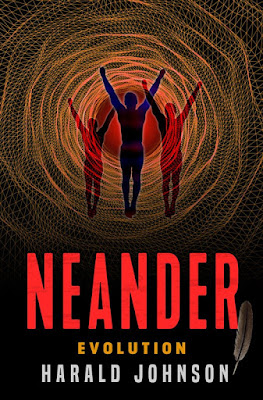
NEANDER: EVOLUTION by Harald Johnson @AuthorHarald #RBRT #TuesdayBookBlog

4 out of 5 stars


On Amazon
On Goodreads


How I discovered this book: it was submitted to Rosie's Book Review Team, of which I am a member.

In a Nutshell: Book #3 of a time travel series between now and 40K years ago.

Evolution is the final book in the highly original and well-researched Neander trilogy, in which science journalist Tom finds himself back in prehistoric times, and develops a life there, whilst keeping the portal to the present (and, as he discovers, the future) open.

His journeys between the worlds have not remained a secret, and scientists dedicated to genetic modification are anxious to milk this opportunity for all they can - while Tom, back in pre-history, wants to strengthen and educate the Neanderthal people he has grown to love, so that they will not be rendered extinct by the Sapiens.

The portal between the worlds is becoming unreliable, with Tom returning to the present and finding it to be the future - there is also an instance of a return to times much longer ago.  I loved this idea, and wished there had been more of it; I would have loved to see the world through Tom/Rusty's eyes before man, or, say, about five thousand years ago.  As with the other books, the narrative flows well and I read it quickly, anxious to know what was going to happen.

This is a great idea, the books are well-written, though I think it could have been explored still further - Tom talks about changing the present by actions he takes in the past, a most fascinating concept, and I would have loved to see more of this.  However, these are Harald Johnson's books, not mine, and as such I am not telling him what to write!  Suffice to say that if he decides to return to this world, I will be happy to read the results.

(Incidentally, I was most interested to read that prehistoric people were biologically unable to tolerate the milk of goats, or cows when they were introduced.  Humans being lactose tolerant is a relatively new phenomena; bearing in mind the amount of people who find that many minor ailments clear up once they stop taking in dairy produce makes me wonder how the change came about.)  


Monday, 14 February 2022

LOYALTY IN CONFLICT by April Taylor @authapriltaylor #TuesdayBookBlog

 4 out of 5 stars


On Amazon
On Goodreads


How I discovered this book: I know the author from Twitter and heard she was writing about this time period, one that always interests me.

In a Nutshell: Schemes and skulduggery during the Wars of the Roses!

Loyalty in Conflict is set in the period of the Wars of the Roses when Edward IV had been king for ten years, and when his brother George, Duke of Clarence, had teamed up with the Earl of Warwickshire to support the other side.  In case you are not familiar with this time in history, April Taylor has provided a brief and helpful summary of the state of play at the time when this story starts.

As the story is named 'A Gideon Rooke Adventure', I assume there will be more; Gideon is the son of the marshal at Lord Richard Welles' Lincolnshire manor at Eresby.  He works in the stable, though his basic intelligence must be hidden in a time when those of his station were thought of as dim-witted.

The household supports the red rose, but Gideon's father believes that Edward IV is the king the country needs, and sets out a plan for Gideon to inform the king about a planned rebellion.

The book is flows so well, a very 'easy read', sometimes with an almost 'cosy mystery' feel to it.  Gideon's personal development once he steps outside his own little world is most interesting, and the characters of Edward and Richard, Duke of Gloucester (later Richard III) were just as I've always imagined them.  As I often find with historical fiction of this period, an aspect that I loved was the detail that showed how people lived in this time; the book is clearly well researched.

Later in the book is a detailed account of Gideon's impression of the battlefield, which is shocking and moving, and shows that battle is no glorious adventure.  I look forward to reading more about this world that April Taylor has created.